
Discount Calculator
This discount calculator turns a price tag and a percent-off sign into real numbers: how much you save, the sale price, and the final total once optional sales tax is added.
Your discount and final price
How the discount calculator works
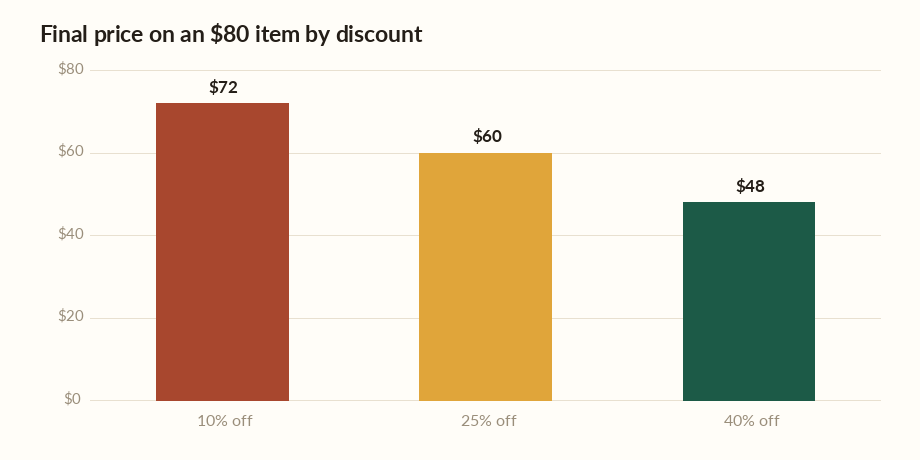
First it multiplies the original price by the discount percentage to find your saving: 25 percent off $80 is $20. Subtracting that leaves a sale price of $60. If you enter a sales-tax rate, the calculator applies it to the discounted price – not the original – so 7 percent tax on $60 adds $4.20 for a final total of $64.20.
Applying tax after the discount matters, because tax is charged on what you actually pay. Leave the tax field at zero if you only want the pre-tax sale price, or set it to your local rate for the true out-the-door number.
Reading a sale like a discount calculator
Retail signs are designed to feel like bigger savings than they are. A quick way to sanity-check any deal is to work out the actual dollars off rather than trusting the headline percentage. The FTC warns about misleading and drip pricing at consumer.ftc.gov, where a “was” price may have been inflated to make the discount look steeper.
Stacking offers can be genuinely valuable – a percentage off plus a coupon – but the order matters and tax is usually added last. For general guidance on taxes and consumer rights, usa.gov is a reliable reference. Run the final number here before you decide the sale is worth it.
Common discount questions the calculator answers
Percentages can be deceptively hard to do in your head, especially once tax enters the picture. “40 percent off” sounds like almost half, but on a $30 item it is $12 – useful, not life-changing. Seeing the actual dollar figure keeps expectations grounded and helps you decide whether a trip to the store is worth it for the saving on offer.
The calculator also settles the classic order-of-operations question. Discounts always come off the original price first; sales tax is added to whatever you actually pay after the discount. Getting that sequence right is the difference between a rough guess and the exact number that will appear on your receipt at the register.
Because it recalculates as you type, it doubles as a quick what-if tool: try the item at 20, 30 and 40 percent off to see the threshold where the deal finally tips into worth-it territory for you.
Frequently asked questions
How do I calculate a discount?
Multiply the original price by the discount percentage to get the amount off, then subtract it from the price. For example, 25 percent off $80 is $20 off, giving a sale price of $60.
Is sales tax applied before or after the discount?
After. Sales tax is charged on the discounted price you actually pay, so the calculator applies your tax rate to the sale price, not the original price.
How do I calculate the final price after a percent off?
Subtract the discount from the original price, then add any sales tax to that result. This calculator shows the savings, the sale price and the final total in one view.
Can I stack two discounts?
Apply the first discount, then run the sale price back through as the new original price with the second percentage. Coupons and percentage offers often combine, but check the store’s rules.
What is 20 percent off $50?
Twenty percent of $50 is $10, so the sale price is $40 before tax. Enter your own numbers above to check any other discount instantly.
Comparing deals across pack sizes too? Use the price per unit calculator, or browse all our everyday calculators.