
Price Per Unit Calculator
This price per unit calculator compares two products side by side – each with its own price and quantity – and tells you which one is cheaper per unit and by how much, so the bigger box never fools you again.
Which is the better deal?
How the price per unit calculator works
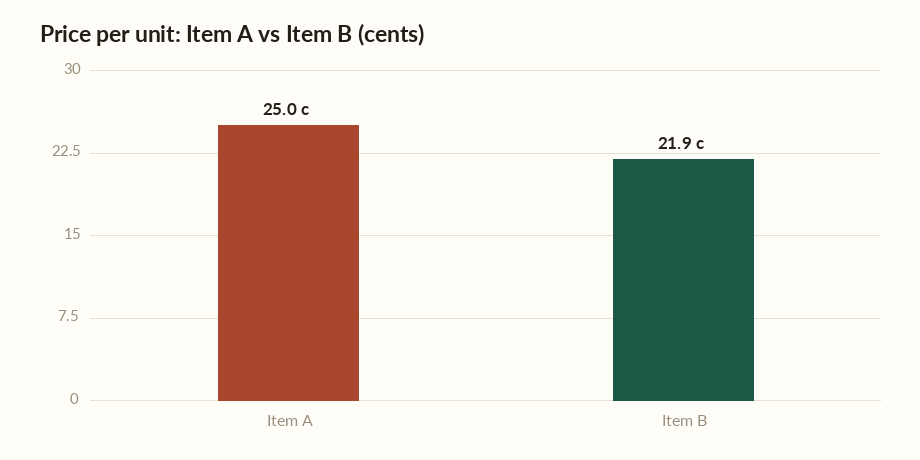
For each option it divides the price by the quantity to get a unit price, then compares the two. Item A at $5.00 for 20 units is $0.25 each; Item B at $7.00 for 32 units is about $0.219 each. Item B is cheaper, and the tool shows the gap as a percentage – here roughly 12.5 percent – so you know exactly how much the better choice saves.
The two quantities do not have to match, which is the whole point: real packages come in odd sizes precisely because that makes head-to-head comparison hard. Reducing both to a price per single unit removes the guesswork. Just be sure both quantities are counted in the same kind of unit.
When the bigger package is not the bargain
Buying in bulk usually lowers the unit price, but not always. A multi-buy promotion, a coupon, or plain shrinkflation can make the smaller pack the cheaper one per unit. Comparison shopping is one of the most reliable ways to stretch a budget, and the FTC has practical advice at consumer.ftc.gov.
It also helps to factor in waste. The cheapest unit price is no saving if half the larger package spoils before you use it. For general consumer-protection resources and how to shop smart, usa.gov is a solid starting point. Weigh the unit price against how much you will actually use.
Turning unit price into a shopping habit
The fastest way to use this is to build it into a quick routine at the shelf. Note the price and size of the option you would normally grab, then do the same for the alternative next to it, and enter both. Within seconds you know which is cheaper per unit and by how much – no mental arithmetic, no rounded guesses.
Over a year, small per-unit gaps compound into real money on the things you buy again and again: coffee, laundry detergent, pet food, paper goods and pantry staples. The point is not to obsess over pennies, but to stop overpaying on autopilot. When two options are genuinely close, buy whichever you will finish without waste.
Frequently asked questions
How do I compare price per unit?
Divide each product’s price by its quantity to get a unit price, then pick the lower one. This calculator does both divisions and shows the percentage difference automatically.
What if the two packages use different units?
Convert them to the same unit first – for example, change grams to ounces – then compare. Comparing across different units directly will give a misleading answer.
Is the lowest unit price always the best buy?
Usually, but consider whether you will use it all. A lower unit price is not a saving if the larger quantity expires or goes to waste before you finish it.
How is this different from the cost per unit calculator?
The cost per unit calculator finds the unit price of a single item. This price per unit calculator compares two different products to show which is the better deal.
Does it store the prices I enter?
No. Everything runs in your browser and nothing is saved or sent anywhere. Refresh the page and the fields reset.
Working out one item on its own? Try the cost per unit calculator, or see all our everyday calculators.