
Break-Even Calculator
This break-even calculator shows exactly how many units you must sell — and how much revenue you must earn — before your business starts making a profit. Enter your fixed costs, price, and variable cost per unit to see the point where money in finally covers money out.
Break-Even Calculator
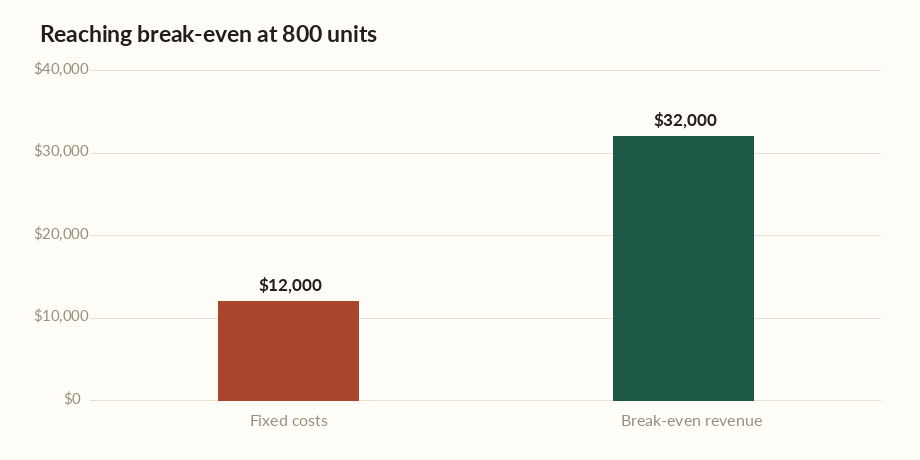
How the break-even calculator works
The break-even calculator relies on one central idea: the contribution margin. That is the price of a unit minus its variable cost — the money each sale contributes toward covering your fixed costs. If you sell a product for $40 and it costs $25 in materials and labor, each unit contributes $15.
Break-even units are then fixed costs divided by the contribution margin: $12,000 ÷ $15 = 800 units. Multiply those units by the price and you get break-even revenue: 800 × $40 = $32,000. Sell one unit past that point and you begin turning a profit.
Fixed costs versus variable costs
Fixed costs stay the same no matter how much you sell — rent, insurance, salaries, software subscriptions. Variable costs rise and fall with each unit produced, such as raw materials, packaging, and payment processing fees. Sorting your expenses into these two buckets is the hardest part of a break-even analysis, and getting it right is what makes the answer trustworthy.
Some costs are mixed. A phone plan with a flat fee plus per-minute charges has both a fixed and a variable part; split it accordingly so the contribution margin stays accurate.
Worked example
Imagine a coffee cart with $3,000 in monthly fixed costs, selling drinks at $5 with $1.50 in variable cost each. The contribution margin is $3.50, so break-even is $3,000 ÷ $3.50 ≈ 858 drinks a month, or about 29 a day. If the owner raises the price to $5.50, the margin climbs to $4.00 and break-even drops to 750 drinks.
That sensitivity is the real value of the tool: small changes in price or cost move the break-even point sharply, so you can test a pricing decision before committing to it.
Where to learn more
The U.S. Small Business Administration walks through break-even analysis as part of writing a business plan, and the Internal Revenue Service explains which business expenses are deductible — useful context when you separate fixed and variable costs. Both are reliable, free starting points.
Frequently asked questions
What does break-even mean?
Break-even is the sales level at which total revenue exactly equals total costs, so profit is zero. Below it you lose money; above it you profit. It is a key milestone for any new product or business.
What is contribution margin?
Contribution margin is the selling price of a unit minus its variable cost. It is the amount each sale contributes toward fixed costs and, once those are covered, toward profit.
Why must price exceed variable cost?
If price is less than or equal to variable cost, each sale loses money and no volume will ever cover fixed costs. The contribution margin must be positive for a break-even point to exist.
Does break-even include taxes and profit goals?
The basic version does not. It only covers costs. To find the units needed for a target profit, add that profit to your fixed costs before dividing by the contribution margin.
Run the break-even calculator whenever you change a price, add overhead, or launch a product, then use it alongside a profit margin calculator to price with confidence. For deeper guidance see the U.S. Small Business Administration and the IRS guide to business expenses.