
Recipe Converter Calculator
Recipes cross borders, but their units do not always follow. This recipe converter calculator switches between cups, tablespoons, millilitres, grams, ounces, and oven temperatures, so a metric recipe and an imperial kitchen finally speak the same language.
Convert recipe units, metric and imperial
How the recipe converter calculator works
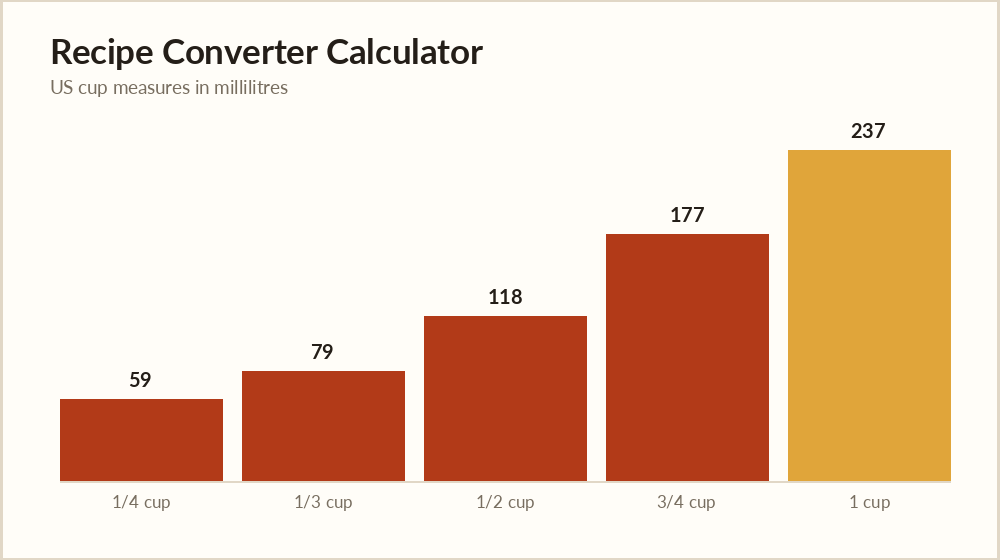
Each unit is defined against a base: volumes in millilitres, weights in grams. The recipe converter calculator turns your amount into that base, then divides into the target unit. One US cup is 236.6 millilitres, so converting a cup to millilitres is a single, exact step with no ingredient guesswork.
Temperatures use their own formula rather than a simple ratio, converting Fahrenheit and Celsius through the standard offset. Because volume and weight are different physical quantities, the tool only converts within a matching type and flags a mismatch if you try to turn cups directly into grams.
A worked example
A British recipe lists 250 millilitres of milk and your measuring set is in cups. Enter 250, choose millilitre as the from unit and cup as the to unit, and the calculator returns about 1.057 cups, just over one cup. Round to a cup for cooking, or measure precisely for baking.
Converting 8 ounces of an ingredient to grams gives about 226.8 grams, and a 425 F oven becomes about 218 C. Each conversion is direct and exact because both sides share the same physical dimension.
When a recipe converter calculator is not enough
Volume and weight cannot convert into each other without knowing the ingredient, because a cup of flour and a cup of honey weigh very different amounts. When a recipe asks you to turn cups into grams, you need a density, which is exactly what the cups to grams calculator provides. For the reference weights themselves, the King Arthur ingredient weight chart is the standard.
For baking especially, weighing beats measuring by volume, a point the King Arthur Baking success guide makes clearly. To resize a recipe as well as reunit it, pair this with the recipe scaler calculator, all linked from the kitchen calculators hub.
Two habits make unit conversion painless. First, decide early whether you will work in metric or imperial for the whole recipe rather than switching mid-list, which is where mistakes creep in. Second, convert once and write the results straight onto the recipe, so the next time you cook it the numbers are already in your kitchen’s units.
Liquids are the easy case because millilitres and grams are nearly identical for water-based ingredients. Dry goods are where volume and weight part ways, and that is the moment to reach for a scale.
Frequently asked questions
How many millilitres in a cup?
A US cup is 236.6 millilitres. A metric cup used in some countries is 250 millilitres, so check which standard your recipe follows. The recipe converter calculator uses the US cup.
Can this convert cups to grams?
Not directly, because volume and weight depend on the ingredient. Use the cups to grams calculator instead, which applies each ingredient density to make that conversion accurate.
How do I convert ounces to grams?
Multiply ounces by 28.35. The recipe converter calculator does this for you, so 8 ounces becomes about 227 grams in one step.
Does it convert oven temperatures?
Yes. Choose degrees Fahrenheit or Celsius as your units and it applies the correct formula, so 350 F converts to about 177 C. For gas marks, use the dedicated oven temperature converter.
Why does it say units must match?
Because you cannot convert a volume into a weight, or either into a temperature, without more information. Pick two units of the same type, such as cup to millilitre or ounce to gram.