
Recipe Scaler Calculator
Cooking for a different crowd? This recipe scaler calculator finds the exact factor to multiply every ingredient by, so a dish built for four can feed six, twelve, or just two without guesswork.
Resize any recipe to the servings you need
How the recipe scaler calculator works
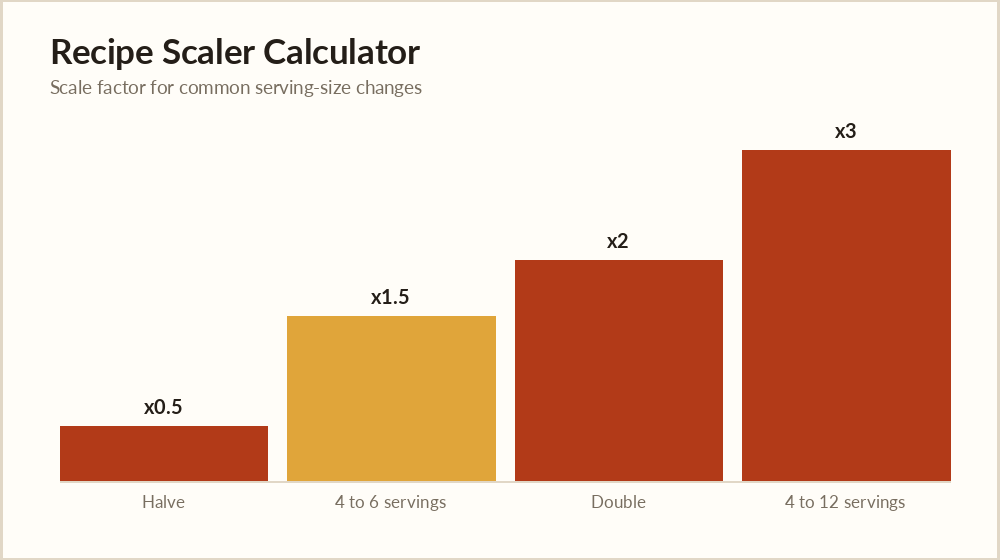
The math behind scaling a recipe is a single ratio. The recipe scaler calculator divides the servings you want by the servings the recipe currently makes, and that number is your scale factor. A recipe for 4 that you want to stretch to 6 has a factor of 6 divided by 4, or 1.5, so every ingredient is multiplied by 1.5.
Enter the original yield, the yield you want, and any single ingredient amount to see it converted. Once you have the factor, apply it across the whole ingredient list. Weight-based ingredients scale cleanly, while items measured in whole units, such as eggs, sometimes need a judgment call at the nearest sensible amount.
A worked example
Say a cookie recipe makes 24 cookies and calls for 2 cups of flour, 1 cup of sugar, and 2 eggs, but you want 36 cookies. The factor is 36 divided by 24, which is 1.5. Multiply through: flour becomes 3 cups, sugar becomes 1.5 cups, and the eggs become 3.
Going the other way works the same. To take that 24-cookie batch down to 8, the factor is 8 divided by 24, or about 0.333. The flour drops to roughly two-thirds of a cup and the single egg becomes tricky, which is a good moment to beat one egg and use part of it, or simply keep the batch at a size that divides evenly.
Tips for accurate scaling
Scaling volume up dramatically can throw off pans, baking times, and seasoning, so treat large jumps as a starting point rather than a guarantee. Salt and strong spices often need slightly less than the raw factor suggests, while baking times change with pan depth rather than in direct proportion. For the most reliable results, weigh ingredients with a scale, as the experts at King Arthur Baking recommend.
When a recipe lists both volume and weight, scale the weights, because they carry through math far more precisely than cups. If you only have cups, our cups to grams calculator turns them into grams first, and the full kitchen calculators hub covers pan sizes and oven temperatures for the rest of the adjustment. You can also cross-check standard ingredient weights on the King Arthur ingredient weight chart.
Frequently asked questions
How do I scale a recipe up or down?
Divide the servings you want by the servings the recipe makes to get a scale factor, then multiply every ingredient by that factor. The recipe scaler calculator does the division and the multiplication for you.
Does scaling change the cooking time?
Usually less than you would expect. Cooking time depends mostly on the depth of food in the pan, not the total quantity, so a doubled batch spread across two pans cooks in nearly the original time. Check for doneness a little early.
How do I handle eggs when scaling?
Eggs come in whole units, so round to the nearest whole egg or beat one and measure out a portion (a large egg is about 50 grams). For small adjustments, rounding to the nearest egg rarely causes a problem.
Should I scale salt and spices by the same factor?
Scale them by the factor as a starting point, but taste before committing, especially when scaling up. Salt, garlic, and hot spices often taste stronger in large batches, so add conservatively and adjust at the end.
Is it better to scale by weight or volume?
By weight. Grams and ounces multiply exactly, while cup measurements vary with how you scoop and pack, which compounds any error when you scale. If you can weigh ingredients, do.