
Oven Temperature Converter
Recipes come from everywhere, and their oven settings rarely match your dial. This oven temperature converter translates any setting between Fahrenheit, Celsius, and British gas marks, and adds the fan-oven adjustment so your bake lands at the right heat.
Convert Fahrenheit, Celsius and gas marks
How the oven temperature converter works
Fahrenheit and Celsius are linked by a fixed formula: Celsius equals Fahrenheit minus 32, multiplied by five and divided by nine. The oven temperature converter runs that formula in both directions, then matches the result to the nearest gas mark using the standard British scale, where gas mark 4 is 180 C, about 350 F, the classic all-purpose baking temperature.
Gas marks are not evenly spaced, so the tool looks them up from a reference table rather than a straight formula. It also subtracts about 20 C for fan or convection ovens, which circulate air and therefore heat food faster than a conventional oven set to the same number.
A worked example
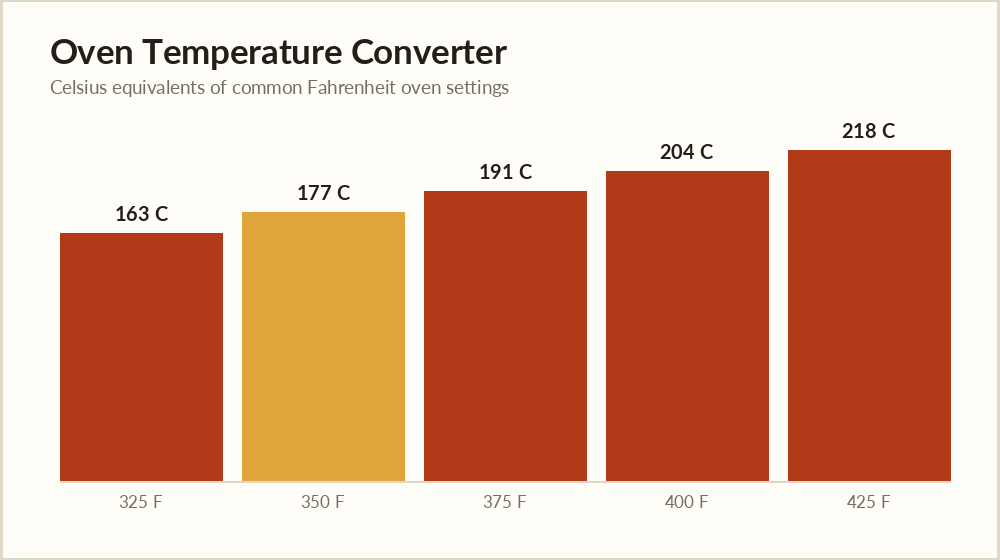
An American cookie recipe says to bake at 375 F, but your oven is marked in Celsius. Enter 375, leave the unit on Fahrenheit, and the converter returns 191 C, gas mark 5, and a fan setting of about 171 C. You now have every version of that temperature on one screen.
Working from a British recipe instead? Enter a gas mark of 6 and the tool shows 200 C and about 392 F, which cookbooks usually round to 400 F, for roasting vegetables or baking bread. Switching between the three scales takes a single tap of the unit selector.
Getting oven temperature right
Ovens are often less accurate than their dials suggest, with real temperatures drifting 15 to 25 degrees from the setting. An inexpensive oven thermometer is the surest fix, and preheating fully before food goes in matters just as much as the number, a point echoed in the King Arthur Baking success guide. Remember too that oven temperature is not the same as a food internal temperature; for meats, verify doneness with a food thermometer using the USDA safe temperature chart.
Pair this with the other conversion tools when you adapt a recipe: the cups to grams calculator handles ingredient weights and the baking pan conversion calculator adjusts for a different tin. Everything sits on the kitchen calculators hub.
It also helps to know a few anchor points by heart. Gas mark 4, 180 C, and 350 F are the same moderate oven that suits most cakes and cookies, while 200 C, 400 F, and gas mark 6 mark the hotter zone for bread and roasting. Once those two settings are familiar, the oven temperature converter fills in everything between them.
Frequently asked questions
What is 350 F in Celsius?
350 F is about 177 C, which rounds to 180 C on most oven dials and equals gas mark 4. It is the standard temperature for a huge range of cakes, cookies, and roasts.
What temperature is gas mark 6?
Gas mark 6 is 200 C, which cookbooks round to 400 F, though an exact conversion of 200 C is about 392 F. It suits roasting vegetables, baking bread, and anything that benefits from a hotter, faster oven.
How much do I lower the temperature for a fan oven?
Reduce a conventional setting by about 20 C or 25 F for a fan or convection oven. The oven temperature converter shows the fan figure automatically.
Why does my oven not match the recipe?
Home ovens commonly run hotter or cooler than the dial by 15 to 25 degrees. An oven thermometer reveals the true temperature so you can adjust the dial to hit the number the recipe wants.
Is 180 C the same as 350 F?
They are close. 350 F is 177 C, usually rounded to 180 C on Celsius ovens. The tiny difference has no practical effect on home baking.