
Crochet Gauge Calculator
The crochet gauge calculator turns a small test swatch into the exact stitch and row counts for your project. Measure how many stitches and rows fit in your swatch, enter your finished dimensions, and it tells you where to start.
Turn your swatch into stitch counts
How the crochet gauge calculator works
Gauge is simply how many stitches and rows fit into a set distance, usually four inches. The crochet gauge calculator divides your swatch stitch count by its width to find stitches per inch, then multiplies by four to give the standard stitches-per-4-inches figure that patterns quote.
To size a project, it multiplies your stitches per inch by the finished width you want, giving the number of stitches to start with, and does the same with rows per inch and your finished length. Matching gauge is what makes a pattern come out the intended size, so always swatch in the yarn, hook, and stitch you plan to use.
Worked example
Suppose your swatch has 16 single crochet stitches across 4 inches and 12 rows over 4 inches. That is 4 stitches per inch and 3 rows per inch, or a gauge of 16 stitches and 12 rows to 4 inches.
For a blanket 40 inches wide and 50 inches long, multiply 4 stitches per inch by 40 to get a starting chain of 160 stitches, and 3 rows per inch by 50 to get 150 rows. Adjust your hook size up or down if your swatch does not match the pattern gauge.
Why gauge matters in the crochet gauge calculator
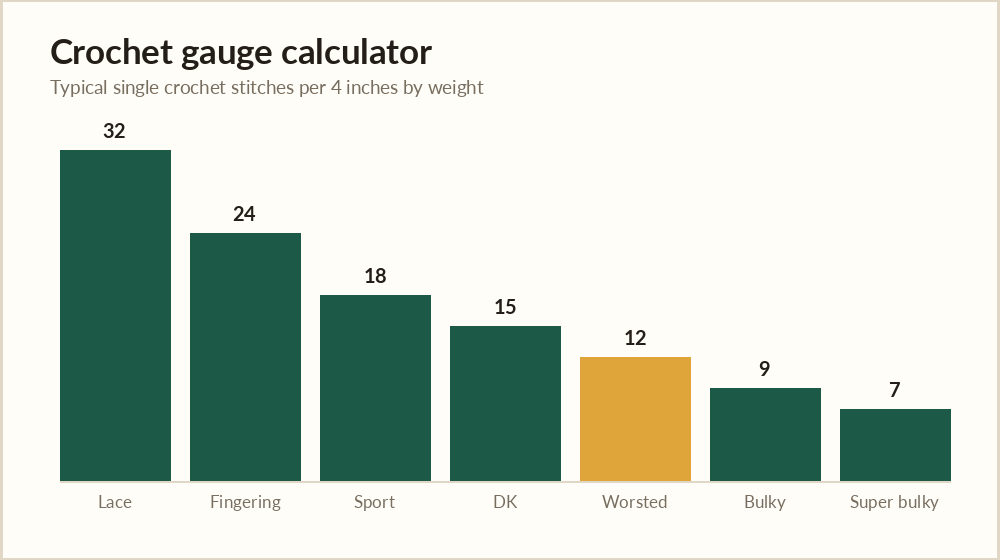
Even half a stitch per inch off can add several inches to a garment, so gauge is the difference between a sweater that fits and one that does not. If you have too many stitches per inch your work is too tight, so go up a hook size; too few and it is too loose, so go down a size. The Craft Yarn Council lists a suggested single crochet gauge for every yarn weight.
Always block your swatch the way you will block the finished piece, because washing can change gauge noticeably. Measure in the center of the swatch rather than at the edges, and count over the largest span you can for accuracy. For more on the concept, see this explanation of gauge.
Related calculators: All craft calculators · Knitting Gauge Calculator · Crochet Blanket Size Calculator
Frequently asked questions
What is gauge in crochet?
Gauge is the number of stitches and rows that fit into a set measurement, usually four inches. Matching the pattern gauge ensures your finished project comes out the intended size.
How big should a gauge swatch be?
Make it at least four inches square, and ideally six, so you can measure across the middle and avoid distorted edge stitches. Use the exact yarn, hook, and stitch pattern from your project.
What if my gauge does not match the pattern?
Change your hook size. If you have too many stitches per inch, the fabric is too tight, so go up a hook size. If you have too few, go down a size, then swatch again to confirm.
Does blocking change gauge?
Yes, often noticeably, especially with wool and cotton. Wash and block your swatch the same way you plan to treat the finished piece, then measure once it is dry for the most reliable numbers.
Why does gauge matter so much?
Small errors multiply across a whole project. Being half a stitch per inch off over 40 inches shifts the width by several inches, which is why matching gauge is the first step in any fitted crochet pattern.