
Crochet Blanket Size Calculator
The crochet blanket size calculator tells you how many stitches to chain and how many rows to work for any blanket size. Choose a preset or enter your own dimensions, add your gauge, and get an exact starting point.
Stitches and rows for any blanket
How the crochet blanket size calculator works
A blanket is really just a big rectangle, so the math is your gauge multiplied by the size you want. The crochet blanket size calculator converts your stitches-per-4-inches gauge into stitches per inch, then multiplies by the width to give the starting chain. It does the same with rows per inch and the length to find the total rows.
That means gauge is everything: the same chain count produces very different widths in fingering versus bulky yarn. Work a small swatch first, measure your true gauge, and enter those numbers so the chain matches the size you actually want. Presets cover common finished sizes from a lovey up to a queen throw.
Worked example
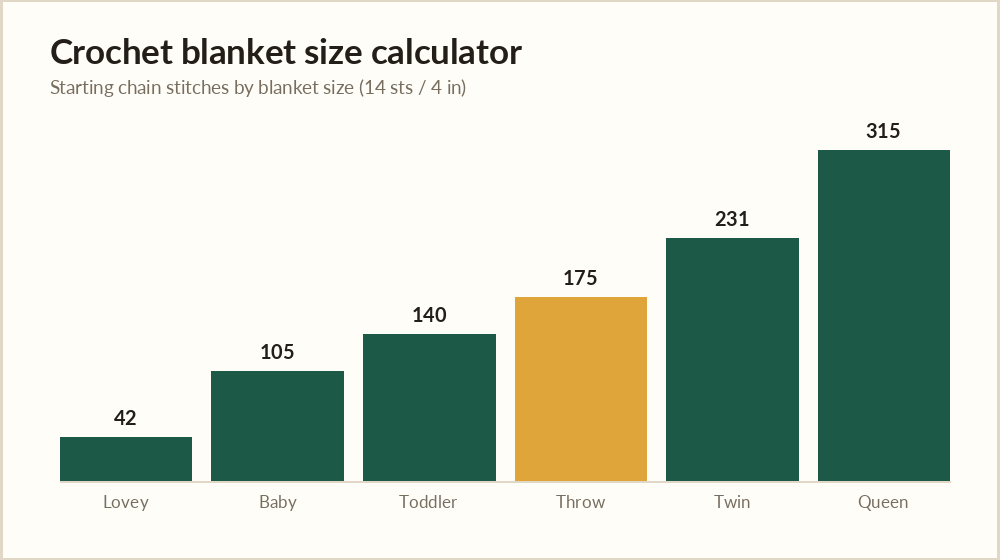
Take a 50 by 60 inch throw worked at a gauge of 14 stitches and 9 rows to 4 inches, which is typical for a light worsted or DK yarn. That is 3.5 stitches per inch and 2.25 rows per inch.
Multiply 3.5 stitches per inch by the 50 inch width to get a starting chain of 175 stitches, and 2.25 rows per inch by the 60 inch length to get 135 rows. Add a few extra chains for a turning edge and to allow for blocking.
Choosing a size with the crochet blanket size calculator
Standard finished sizes are a handy starting point: a lovey is about 12 inches square, a baby blanket 30 by 35 inches, a toddler blanket 40 by 50, a throw 50 by 60, and a twin around 66 by 90 inches. Adjust to taste, since many crafters like a slightly larger throw for extra coverage. The Craft Yarn Council lists a suggested gauge for each yarn weight to plug in.
If your stitch pattern has a repeat, round the starting chain up or down to the nearest multiple of that repeat, plus any turning chains the pattern needs. Border rounds add width and length too, so subtract a little from your target if you plan a deep edging. For general sizing guidance, the standard measurements charts can help with wearable blankets and wraps.
Related calculators: All craft calculators · Crochet Gauge Calculator · How Much Yarn Do I Need
Frequently asked questions
What size should a crochet blanket be?
Common sizes are a 12 inch lovey, a 30 by 35 inch baby blanket, a 40 by 50 inch toddler blanket, a 50 by 60 inch throw, and roughly 66 by 90 inches for a twin bed. Pick the closest and fine-tune to your preference.
How many chains do I need for a blanket?
Multiply your stitches per inch by the width in inches. At 3.5 stitches per inch, a 50 inch throw needs about 175 chains, plus any turning chains. Your gauge is the deciding factor, so swatch first.
How does yarn weight affect blanket size?
Heavier yarn means fewer stitches per inch, so the same chain count makes a wider blanket. Always base your chain on the gauge of the exact yarn and hook you will use, not on a generic number.
Should I account for the border?
Yes. A border adds to both width and length, so if you want an exact finished size, work the main panel a little smaller and let the edging bring it up to size. A deep border can add several inches all around.
How do I keep the edges straight?
Keep your stitch count identical on every row and use consistent turning chains. Counting stitches at the end of each row, especially on a wide blanket, prevents the gradual narrowing or widening that shows up over a large piece.