
Cost Per Unit Calculator
This cost per unit calculator divides a total price by the number of units so you can see the true price of each one – and tell at a glance whether the big pack is really the better deal.
Cost per unit
How the cost per unit calculator works
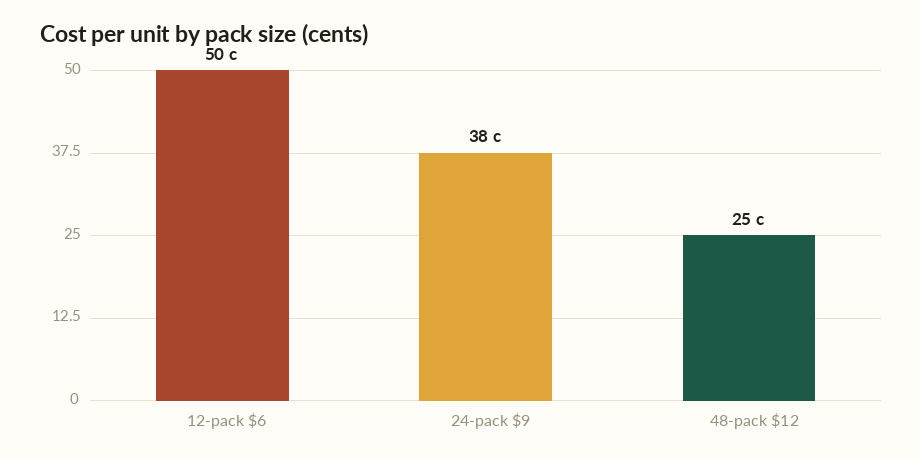
It performs one clean division: total price divided by the number of units. A $12 box of 48 items costs $0.25 each. To make small differences easy to read, the tool also scales that up to a cost per 10 and per 100 units, so 25 cents each becomes $2.50 per ten and $25.00 per hundred.
A unit can be anything you buy in quantity - tablets, ounces, sheets, servings, diapers, or feet of cable. As long as you enter the price and the matching count in the same units, the per-unit figure is exact and updates the moment you change either field.
Why unit price beats the sticker price
The shelf sticker tells you what leaves your wallet today; the unit price tells you what you actually pay for the product. A bigger package usually - but not always - costs less per unit, and the only way to be sure is to compare like for like. Many stores print a unit price on the shelf tag; the standards behind those tags come from the National Institute of Standards and Technology at nist.gov.
Comparison shopping this way is one of the simplest ways to cut a grocery bill, and the FTC offers practical guidance on getting the best price at consumer.ftc.gov. Watch out for the occasional case where the smaller size is cheaper per unit - promotions and shrinkflation can flip the usual rule.
A worked example you can copy
Say two stores sell the same detergent. Store A has a 32-load bottle for $8.00; Store B has a 50-load bottle for $11.50. Enter $8.00 and 32 for the first, and you get $0.25 per load. Enter $11.50 and 50 for the second, and you get $0.23 per load. The larger bottle wins by two cents a load, which is roughly an 8 percent saving every time you do laundry.
That two-cent gap looks trivial, but across dozens of loads a year it adds up - and the same logic applies to coffee pods, printer paper, pet food and vitamins. Running each option through the cost per unit calculator turns a vague hunch about value into a number you can trust.
Frequently asked questions
How do I calculate cost per unit?
Divide the total price by the number of units. For example, $12 for 48 units is $12 divided by 48, which equals $0.25 per unit. This calculator does the division and also shows cost per 10 and per 100.
What counts as a unit?
Whatever you are buying in quantity: ounces, tablets, sheets, servings, or individual items. Just make sure the quantity you enter matches the units you want the price expressed in.
Is a bigger pack always cheaper per unit?
Usually, but not always. Promotions, coupons and shrinkflation can make a smaller size cheaper per unit, so it pays to check rather than assume.
How is this different from price per unit?
Cost per unit finds the price of one item within a single package. The price per unit calculator compares two different products side by side to show which is the better value.
Can I compare different units like ounces and grams?
Convert both to the same unit first, then compare. Comparing a per-ounce price with a per-gram price directly will give a misleading result.
Comparing two specific products? Use the price per unit calculator, or see all our everyday calculators.