
Running Pace Calculator
This running pace calculator turns a distance and finish time into your pace per kilometer and per mile, plus your speed. Use it to plan race goals or check your training runs.
Running pace calculator
How the running pace calculator works
Pace is simply time divided by distance. This running pace calculator takes the time you enter and divides it by your distance to give a pace per kilometer and per mile, then converts that into speed. Run 5 kilometers in 25 minutes and your pace is 5:00 per kilometer, or about 8:03 per mile, at a speed of 12 km/h.
Estimates for general information only; not medical or fitness advice. Build mileage gradually and consult a doctor before starting a new running program.
A worked example
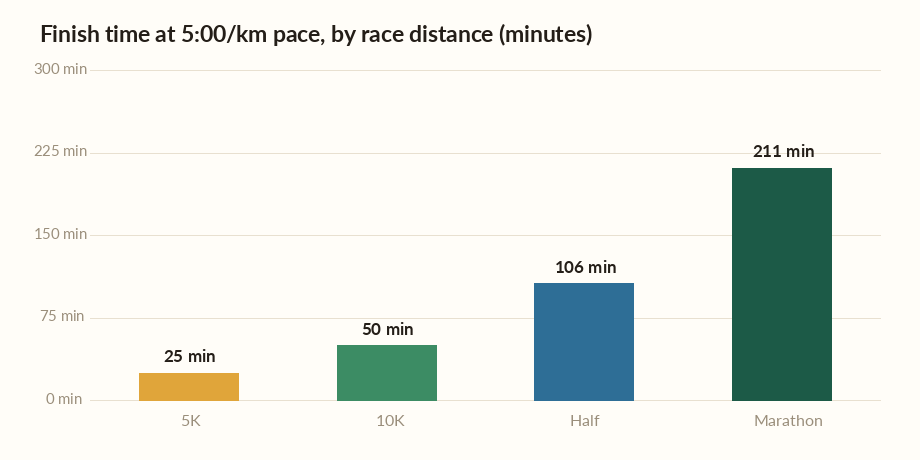
Say you finish a 5K in 25 minutes flat. That is 1,500 seconds over 5 kilometers, which works out to 300 seconds - 5 minutes - per kilometer. Converting to miles, 5 kilometers is about 3.11 miles, so the same run is roughly 8:03 per mile. Hold that pace and a 10K takes about 50 minutes, a half marathon just under 1 hour 46 minutes, and a full marathon around 3 hours 31 minutes.
This is why pace is such a useful training number: once you know a comfortable pace, you can predict finish times across distances and set realistic race goals.
Training smarter with the running pace calculator
Most training plans mix paces rather than running every session at race speed. Easy runs should feel conversational, often 60 to 90 seconds per kilometer slower than race pace, while interval and tempo work runs faster. Knowing your paces keeps easy days easy and hard days hard - the balance that drives improvement and reduces injury risk.
Health agencies including the Centers for Disease Control and Prevention recommend regular aerobic activity, and running resources from MedlinePlus stress building mileage gradually. Use this calculator to set paces you can sustain, not just the ones you wish you could hit. Revisit your paces every few weeks as your fitness improves, since the pace that felt hard in week one often becomes a comfortable steady effort a month later, and your training targets should move with you.
Frequently asked questions
How do I calculate my running pace?
Divide your total time by the distance. For example, 25 minutes over 5 kilometers is 5:00 per kilometer. This running pace calculator does the math and also converts to pace per mile and speed.
What is a good 5K pace?
It varies widely by fitness and age. Many recreational runners finish a 5K between 25 and 35 minutes, which is roughly 5:00 to 7:00 per kilometer. The best pace is one you can sustain and build from.
How do I convert pace per km to per mile?
Multiply your per-kilometer pace by 1.609 to get per-mile pace. A 5:00/km pace becomes about 8:03/mile. The calculator shows both automatically.
What pace should my easy runs be?
Easy runs are typically 60 to 90 seconds per kilometer slower than your race pace and should feel conversational. Keeping easy days truly easy is key to consistent training.
Can I use this to predict a marathon time?
You can estimate a marathon time by holding a pace across the distance, but real marathon pace is usually slower than 5K or 10K pace because of the greater endurance demand. Treat predictions as a starting point.
Fueling your runs? Check hydration with our water intake calculator or plan recovery nutrition with the protein intake calculator.