
One Rep Max Calculator
This one rep max calculator estimates the most weight you could lift for a single rep, based on a weight and rep count you already know. It uses the Epley formula and adds a training percentage table.
Your one-rep max
How the one rep max calculator works
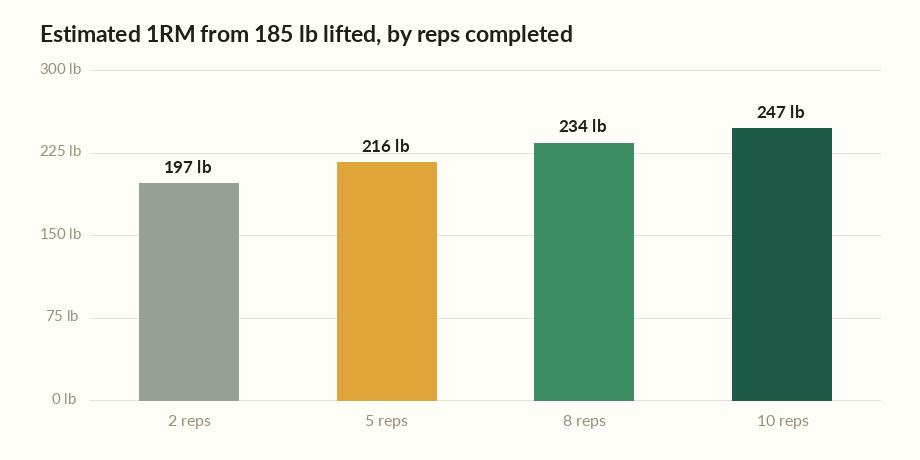
Your one-rep max (1RM) is the heaviest weight you can lift for a single repetition of an exercise. Testing it directly is risky, so this one rep max calculator estimates it from a set you have already done. It uses the Epley formula: 1RM equals the weight lifted multiplied by (1 plus reps divided by 30). Lift 185 pounds for 5 reps and it estimates a 1RM of about 216 pounds.
Estimates for general information only; not medical or fitness advice. Lifting near your one-rep max carries injury risk – train with proper form, a spotter, and professional guidance.
A worked example
Suppose you bench press 185 pounds for 5 clean reps. Plugging in: 185 times (1 plus 5 over 30) equals 185 times 1.167, which is roughly 216 pounds. The estimate is most accurate in the 1-to-10 rep range; past about 12 reps, fatigue and endurance skew the number, so the calculator caps its accuracy there.
The percentage table then turns that 1RM into working weights. Many strength programs prescribe sets at a percentage of 1RM – for example, 5 sets of 5 near 80 percent for strength, or higher-rep sets around 65 to 70 percent for muscle growth.
Using the one rep max calculator to program lifts
Treat the result as an estimate, not a guarantee. Different formulas (Epley, Brzycki, Lombardi) give slightly different numbers, and your true max depends on the lift, your technique, and the day. Use the percentage table to plan training loads, then adjust based on how the weight actually feels. Warm up thoroughly and never attempt a true one-rep max without proper preparation and a spotter.
The Centers for Disease Control and Prevention recommends muscle-strengthening activity on two or more days a week, and resources like the MedlinePlus guide to exercise benefits explain how strength training supports overall health. This calculator helps you train at the right intensity within that framework.
Frequently asked questions
What is a one-rep max?
Your one-rep max, or 1RM, is the maximum weight you can lift for a single repetition of an exercise with good form. It is a common benchmark for strength and for setting training loads.
How accurate is the one rep max calculator?
Estimates are most accurate when based on sets of 1 to 10 reps. Beyond about 12 reps, endurance rather than strength dominates, so the estimate becomes less reliable. Treat it as a close approximation.
Which 1RM formula does this use?
This calculator uses the Epley formula: 1RM equals weight times (1 plus reps divided by 30). It is one of the most widely used estimators and tracks closely with other common formulas in the low-rep range.
How do I use 1RM percentages?
Many programs set working weights as a percentage of 1RM – roughly 80 percent for strength sets of about 5 reps, or 65 to 70 percent for higher-rep hypertrophy work. The table gives these loads instantly.
Should I test my true one-rep max?
Testing a true max carries injury risk and is unnecessary for most lifters. Estimating from a submaximal set is safer and gives you the numbers you need to program training.
Building strength and nutrition together? See our protein intake calculator and the macro calculator to fuel your training.