
YouTube Money Calculator
This YouTube money calculator estimates how much a channel can earn from ads based on its views and RPM — the revenue a creator keeps per thousand views. Enter your monthly views and an RPM to see daily, monthly, and yearly earnings.
YouTube Money Calculator
How the YouTube money calculator works
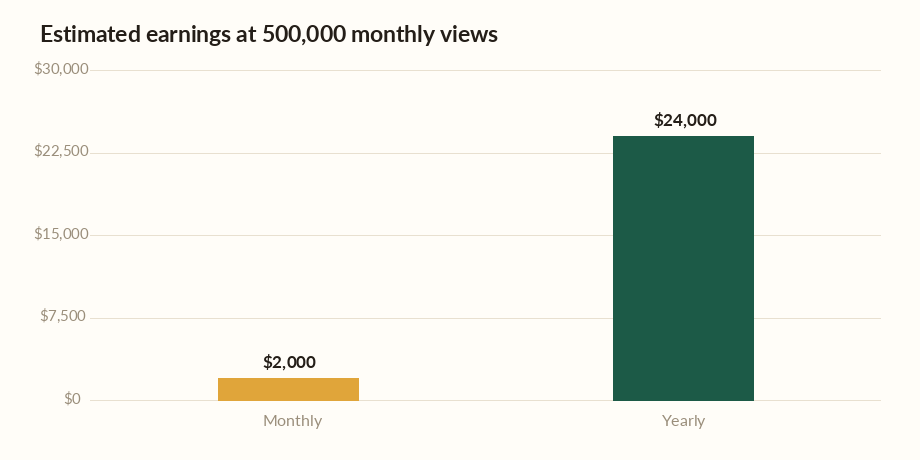
The YouTube money calculator uses one core figure: RPM, or revenue per mille (per thousand views). It multiplies your monthly views by the RPM and divides by 1,000. At 500,000 views and a $4 RPM, that is 500,000 ÷ 1,000 × $4 = $2,000 a month, which scales to roughly $24,000 a year and about $66 a day.
RPM already reflects YouTube’s revenue split, so it represents money the creator actually keeps — not gross ad spend. That makes it a more honest basis for an estimate than the older CPM figure, which is what advertisers pay before YouTube takes its share.
Why RPM varies so much
RPM is not fixed. It swings with your niche, your audience’s country, the time of year, and how many of your views actually show ads. Finance, business, and technology channels often see RPMs of $10 or more, while gaming, entertainment, and content aimed at younger viewers can sit closer to $1 to $3.
Seasonality matters too: advertiser budgets surge in the fourth quarter, so December RPMs are typically the highest of the year and January the lowest. Because of this range, the calculator is a planning tool, not a promise — try a low and a high RPM to bracket your likely earnings.
Ads are only part of the income
Most established creators earn well beyond ad revenue. Channel memberships, Super Chats, brand sponsorships, affiliate links, and merchandise often out-earn ads entirely. A sponsorship alone can pay more for a single video than a month of ad revenue at the same view count.
To join the YouTube Partner Program and earn ad money in the first place, a channel generally needs to meet subscriber and watch-hour thresholds set by YouTube. Until then, the ad estimate here is what you are working toward rather than earning.
Where to learn more
YouTube’s official Creator resources explain how monetization, RPM, and the Partner Program work, and the U.S. Small Business Administration offers guidance on treating content creation as a business, including taxes and expenses. Both are useful once your channel starts earning.
Frequently asked questions
How much does YouTube pay per 1,000 views?
It depends on RPM, which commonly ranges from about $1 to over $10. Many channels land between $2 and $5 per thousand views after YouTube’s share, but niche and audience location move this significantly.
What is the difference between CPM and RPM?
CPM is what advertisers pay per thousand ad impressions before YouTube’s cut. RPM is what the creator actually keeps per thousand video views after the split. RPM is the better figure for estimating your own earnings.
Why is my RPM low?
Common reasons include a niche with cheap ads, a large share of viewers in lower-paying regions, short videos with fewer ad slots, or a season when advertiser budgets are low. RPM often rises in the fourth quarter.
Is ad revenue the only way to make money on YouTube?
No. Memberships, Super Chats, sponsorships, affiliate marketing, and merchandise are often larger income sources than ads, especially for smaller channels with an engaged audience.
Treat the YouTube money calculator as a range-finder: test a pessimistic and an optimistic RPM to see the spread. For official rules see YouTube for Creators and, for the business side, the U.S. Small Business Administration. Ad-supported sites can also try the AdSense revenue calculator.