
Self-Employment Tax Calculator
This self-employment tax calculator estimates the Social Security and Medicare tax you owe on your net profit, and shows the deductible half you can claim against income tax. Enter your net self-employment profit to see the full breakdown.
Self-Employment Tax Calculator
How the self-employment tax calculator works
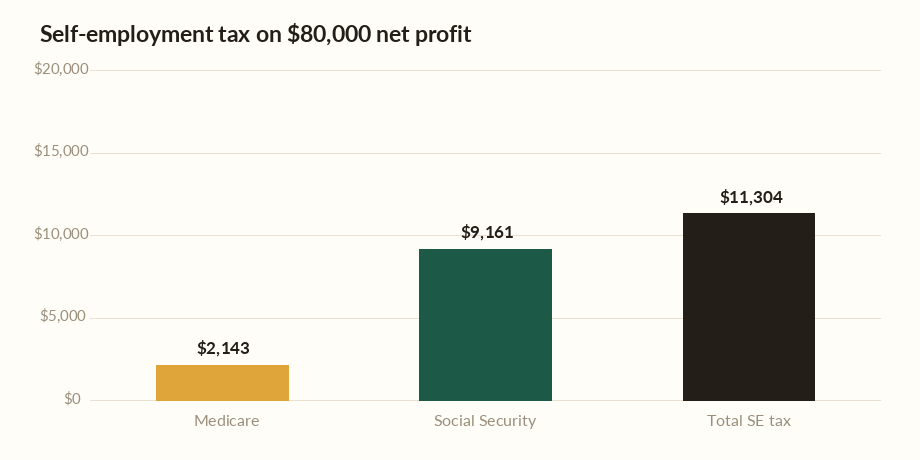
Self-employment tax is Social Security and Medicare tax for people who work for themselves. The self-employment tax calculator first multiplies your net profit by 92.35% to get the taxable base — this adjustment reflects the employer-share deduction built into the law. On $80,000 of profit, the base is $73,880.
It then applies 12.4% for Social Security (up to the annual wage base of $168,600 in 2024) and 2.9% for Medicare, which has no cap. Added together that is a 15.3% combined rate, producing about $11,304 in SE tax on our example.
The deductible half
You can deduct one half of your self-employment tax when calculating your federal income tax. In the example that is $5,652. This does not reduce the SE tax itself, but it lowers your taxable income, so the true cost is softer than the headline number suggests.
The deduction is taken as an adjustment to income, meaning you get it whether or not you itemize. It is one of the few automatic breaks that partly offsets the higher tax burden of working for yourself. If you also contribute to a retirement plan such as a SEP-IRA or solo 401(k), those contributions can further reduce the income tax you pay on the same profit, though they do not lower the self-employment tax itself. Layering these adjustments is how many freelancers keep their overall rate manageable.
The Social Security wage base
Social Security tax only applies up to an annual earnings ceiling — $168,600 for 2024. Once your taxable base passes that, the 12.4% portion stops, though the 2.9% Medicare portion keeps going on every dollar. High earners may also owe an extra 0.9% Additional Medicare Tax above certain thresholds, which this simplified estimate does not include.
Because the wage base rises most years, the maximum Social Security portion changes annually. Always check the current figure before relying on an estimate for a high-income year.
Important limitations
This tool estimates federal self-employment tax only. It does not calculate your federal income tax, state tax, the Additional Medicare Tax, or interactions with W-2 wages that already had Social Security withheld. For income tax as well, use a broader estimate, and for anything you file, rely on the official IRS Schedule SE instructions or a qualified tax professional.
Frequently asked questions
What is the self-employment tax rate?
The combined rate is 15.3% — 12.4% for Social Security and 2.9% for Medicare — applied to 92.35% of your net profit. The Social Security portion stops at the annual wage base; Medicare has no cap.
Why is profit multiplied by 92.35%?
The 92.35% factor accounts for the employer-equivalent portion of the tax. It approximates the deduction employees get automatically, so the self-employed are not taxed on that slice.
Can I deduct self-employment tax?
You can deduct half of it as an adjustment to income when figuring federal income tax. On $11,304 of SE tax, that is a $5,652 deduction, available whether or not you itemize.
Do I owe SE tax on a side gig?
Generally yes, if your net self-employment earnings are $400 or more for the year. The tax applies to freelance, gig, and side-business profit, not just full-time self-employment.
Use the self-employment tax calculator to plan your set-aside, then confirm the current wage base and rules with the IRS self-employment tax page and the Social Security Administration. For income tax too, see the freelance tax calculator.