
Retaining Wall Calculator
This free retaining wall calculator shows how many blocks you need. Enter the wall length, height, and block size to get the blocks, courses, and cap blocks.
How many blocks do you need?
How the retaining wall calculator works
The retaining wall calculator divides the wall length by the block face length to get the blocks per course, divides the wall height by the block face height to get the number of courses, multiplies the two, and adds a waste factor. It also returns a cap-block count equal to one course. The formula is (length ÷ block length) × (height ÷ block height) × (1 + waste).
One point that trips people up: the bottom course, called the base course, is buried below grade to lock the wall against sliding. A common rule is one buried course for every 6 to 8 inches of exposed height, so remember to include that hidden row in your wall height. Cap blocks that finish the top are sold separately and often cost more per unit.
Worked example
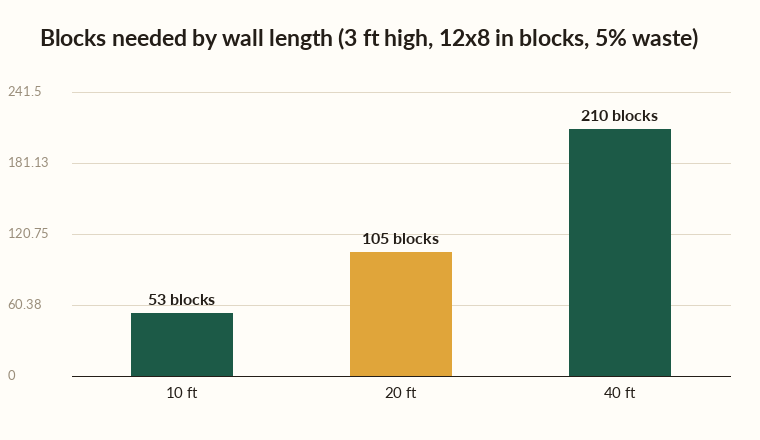
A 20 ft long, 3 ft high wall built from 12-inch by 8-inch blocks needs 20 blocks per course and about 5 courses (36 inches ÷ 8, rounded up), or roughly 100 blocks. Adding 5% waste for cuts brings it to about 105, plus 20 cap blocks. You would also need a leveling trench of compacted gravel and a column of drainage stone behind the wall.
Base, drainage, and when to call an engineer
Blocks are the visible part, but drainage decides whether the wall lasts. Build on a compacted gravel leveling pad in a trench about twice the block depth and at least 6 inches deep, backfill behind the wall with a 12-inch column of clean crushed stone, wrap it in filter fabric, and run a perforated drain pipe at the base to daylight. Poor drainage is the top cause of wall failure.
Anything over about 4 feet carries heavy loads and typically needs a permit and a licensed engineer. The Concrete Masonry & Hardscapes Association sets the SRW installation guidelines, and the Federal Highway Administration covers block durability and performance.
Measuring tips
Measure the wall along its face and decide the finished exposed height, then add the buried base course before counting rows. Confirm the exact block face size with your supplier, since it varies by product line, and order base and drainage stone separately – those aggregates are usually a bigger material line than the blocks themselves.
Frequently asked questions
How many blocks do I need for a retaining wall?
Enter the wall length and height and the block face size, plus a waste factor. The calculator returns the blocks and cap blocks. A 20 by 3 foot wall with 12 by 8 inch blocks needs about 105 blocks.
How do I calculate retaining wall courses?
Divide the wall height in inches by the block face height and round up. A 3-foot (36-inch) wall built from 8-inch-high blocks is about 5 courses, including the buried base course.
Does the bottom row of a retaining wall get buried?
Yes. The base course is set below grade – about one buried course for every 6 to 8 inches of exposed height – so the wall resists sliding. Include that row in your height.
How much gravel does a retaining wall need?
Plan a compacted gravel leveling pad about 6 inches deep and a 12-inch column of drainage stone behind the wall. On longer or taller walls, the aggregate can exceed the cost of the blocks.
Do I need a permit for a retaining wall?
Walls up to about 4 feet are often DIY, but taller walls, or walls holding a slope or surcharge, usually require a permit and a licensed engineer. Always check local codes first.