
Gravel Calculator
This free gravel calculator works out how much gravel to order for a driveway, path, or base layer. Enter length, width, and depth to get the volume in cubic yards and the weight in tons – the two units suppliers quote.
How much gravel do you need?
How the gravel calculator works
The gravel calculator multiplies length by width to find the area, multiplies by the depth in feet to get cubic feet, then divides by 27 for cubic yards. Because most suppliers sell gravel by the ton, it also converts cubic yards to tons using a density of about 1.4 tons per cubic yard for typical crushed gravel. Lighter pea gravel is closer to 1.3 tons per yard and dense crushed stone can reach 1.5, so confirm the figure with your yard for an exact order.
The quick formula is: square feet × depth in inches ÷ 324 = cubic yards, then cubic yards × 1.4 = tons. Gravel also compacts as it is rolled in, so most contractors add 10 to 15% to the loose volume before ordering.
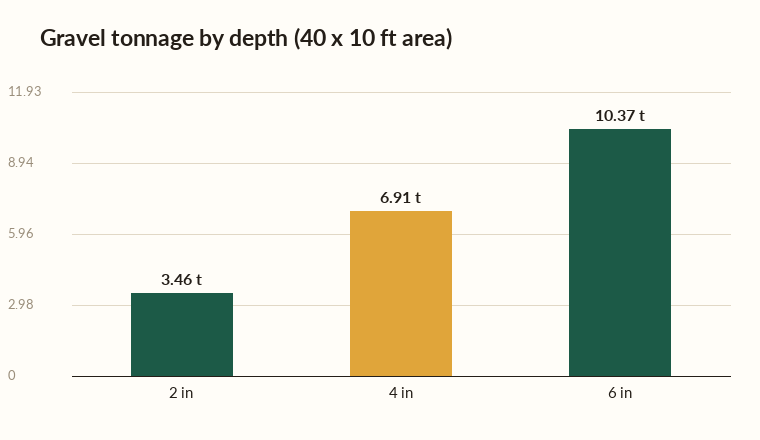
Worked example
A 40 ft by 10 ft driveway at 4 inches deep is 400 square feet × 0.333 ft = 133 cubic feet, or about 4.94 cubic yards. At 1.4 tons per yard that is roughly 6.9 tons. Adding 10% for compaction, you would order about 7.6 tons, which most suppliers round to 8.
Choosing depth and gravel type
A residential gravel driveway usually needs 4 inches of surface gravel over a compacted base, while high-traffic or heavy-vehicle drives use 6 inches or a two-layer build with road base underneath. Paths and garden beds can get by with 2 to 3 inches. Angular crushed stone locks together and resists rutting, whereas smooth pea gravel shifts more and suits decorative areas.
For durable gravel roads and driveways, the Penn State Center for Dirt and Gravel Road Studies covers base preparation and drainage, and the USGS aggregates resource explains how sand, gravel, and crushed stone differ as construction materials.
Cost, delivery, and measuring tips
Gravel price is driven as much by delivery as by the stone itself, so ordering a full truckload usually lowers the cost per ton and one drop-off beats several trips. Crushed base rock is typically cheaper per ton than decorative washed stone or pea gravel. For an odd-shaped area, break it into rectangles, run each through the gravel calculator, and add the results. Always measure the depth you plan to add rather than the depth already there, and excavate an extra inch or two so the finished, compacted surface sits flush with the surrounding grade.
Frequently asked questions
How much gravel do I need?
Enter the length, width, and depth of the area and the calculator returns cubic yards, tons, and cubic feet. As a guide, one ton of gravel covers about 100 square feet at 2 inches deep or 60 square feet at 4 inches.
How many tons are in a cubic yard of gravel?
About 1.4 tons for common crushed gravel, ranging from roughly 1.3 tons for light pea gravel up to 1.5 tons for dense crushed stone. Moisture also adds weight, so ask your supplier for their exact density.
How deep should a gravel driveway be?
Four inches of surface gravel is standard for a residential driveway, with 6 inches or a layered base for heavy use. Paths and borders need only 2 to 3 inches.
How do I convert cubic yards of gravel to tons?
Multiply cubic yards by the density. For typical gravel that is cubic yards × 1.4 = tons. To go the other way, divide tons by 1.4 to estimate cubic yards.
Should I order extra gravel?
Yes. Gravel compacts under traffic and a compactor, losing 10 to 20% of its loose volume, so add about 10 to 15% to avoid a second delivery.