
EV Charging Cost Calculator
Charging an electric car at home is usually far cheaper than filling a tank, but the exact cost depends on your battery, your electricity rate and how efficiently the car drives. This EV charging cost calculator turns those inputs into the cost to fully charge, the cost per mile and the cost per 100 miles. Everything runs in your browser and nothing is saved.
Cost to charge your EV
How the EV charging cost calculator works
The EV charging cost calculator starts with the energy your battery holds and adds a little for charging losses. It divides your battery size by the charging efficiency to get the energy actually drawn from the grid, then multiplies by your electricity rate to get the cost of a full charge. Range added is your battery size times how many miles the car travels per kilowatt-hour, and dividing cost by range gives the cost per mile.
With the defaults – a 60 kWh battery, 16 cents per kilowatt-hour, 90 percent charging efficiency and 3.5 miles per kWh – a full charge costs about 10.67 dollars and returns roughly 210 miles of range. That works out to about 5 cents per mile, or a little over 5 dollars per 100 miles, which is why home charging is so much cheaper than gasoline for most drivers.
Home charging vs public fast charging
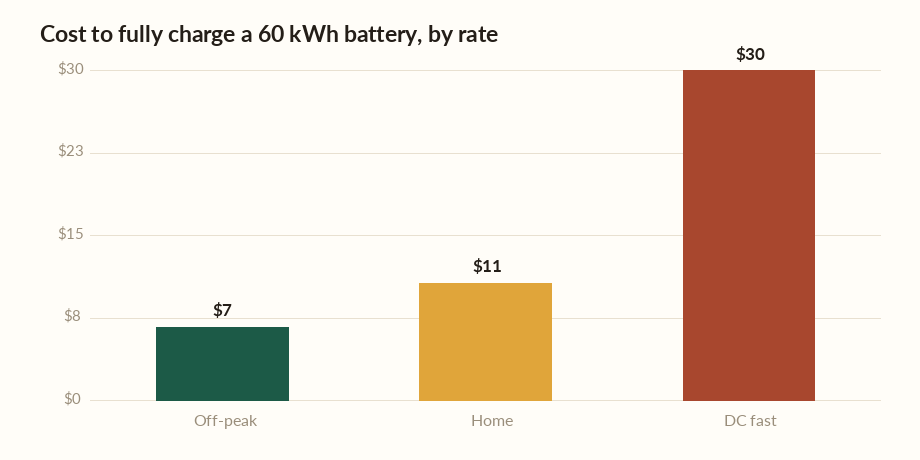
Where you plug in matters more than almost anything else. Overnight home charging on a standard residential rate is the cheapest option, and off-peak time-of-use rates can cut it further. Public DC fast charging is convenient on road trips but often costs two to four times the home rate, as the chart above shows for the same full charge.
To estimate your own numbers, check your utility bill for the rate per kilowatt-hour and look up your car efficiency. The Department of Energy Alternative Fuels Data Center provides a vehicle cost calculator, and the EPA lists official efficiency figures for every model on fueleconomy.gov.
Ways to charge for less
Shift charging to off-peak hours if your utility offers time-of-use pricing, since the overnight rate is often a fraction of the daytime rate. A Level 2 home charger delivers energy faster than a standard outlet, making it easier to top up during the cheapest window. Charging losses are small but real, so a slightly higher efficiency number lowers your cost a little.
Driving style also changes the maths. Gentle acceleration, steady highway speeds and mild climate use all raise your miles per kilowatt-hour, which lowers the cost per mile. Preconditioning the cabin while still plugged in draws from the grid rather than the battery, preserving range.
Frequently asked questions
How much does it cost to fully charge an EV?
It depends on battery size and your electricity rate. A 60 kWh battery at 16 cents per kilowatt-hour costs roughly 10 to 11 dollars for a full charge at home. Enter your own numbers above for a personal estimate.
Is charging an EV cheaper than gas?
For most drivers, yes. Home charging often costs around 5 cents per mile, well below the per-mile fuel cost of a typical gas car, though public fast charging narrows the gap.
What is charging efficiency?
Some energy is lost as heat while charging, so the grid supplies a little more than the battery stores. A charging efficiency around 85 to 90 percent is typical, and the calculator uses it to size the true cost.
Why is public fast charging more expensive?
DC fast chargers cost more to build and operate and are priced for convenience on the road. Rates are often two to four times a home rate, so most owners charge at home whenever possible.
How do I find my cost per mile?
Divide the cost of a charge by the miles it adds, or read it directly from the calculator. Cost per mile lets you compare charging at home against public rates and against gasoline.
These figures are estimates for general information only. Explore more automotive calculators, or see the full picture with the EV vs gas savings calculator.