
Deck Board Calculator
This free deck board calculator shows how many boards you need for a deck. Enter the deck size and board dimensions to get the board count and linear feet to order.
How many deck boards do you need?
How the deck board calculator works
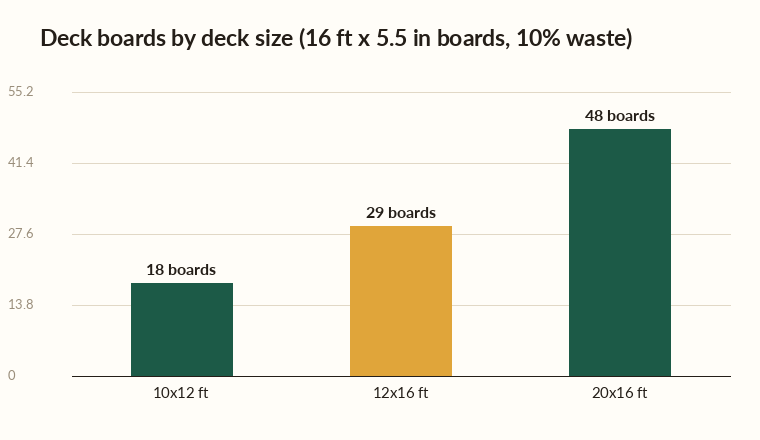
The deck board calculator multiplies the deck length by the width to get the surface area, then divides by the area a single board covers and adds a waste factor. One board covers its length times its face width – remember a “6-inch” board is actually 5.5 inches wide – so a 16-foot board 5.5 inches wide covers about 7.3 square feet. Divide deck area by that, add 10% for cuts, and round up to whole boards.
Lumber yards sell decking by the linear foot, not by square footage, so the calculator also shows the total linear feet to order. When you request a quote, ask for that figure and the board length – for example, “576 linear feet of 5/4×6 in 16-foot lengths” – rather than a square-foot number, which suppliers cannot price directly.
Worked example
A 20 ft by 12 ft deck is 240 square feet. With 16-foot boards 5.5 inches wide, each board covers about 7.3 square feet, so you need roughly 33 boards. Adding 10% for cutting waste brings it to 36 boards, or about 576 linear feet. Order a few extra for stair treads and to keep spares on hand for later repairs.
Gaps, spacing, and structure
The calculator counts the deck surface, but a safe deck is more than its boards. Leave a 1/8-inch gap between wood boards for drainage and expansion, and follow the manufacturer spacing for composite. Boards run perpendicular to the joists, and joist spacing, beam spans, and footings must meet code – never run boards parallel to the joists beneath them.
For the structure under the boards, the American Wood Council DCA6 deck guide is the code-referenced standard for joists, beams, and footings, and this decking methodology reference details the board-count and fastener math.
Ordering tips
Measure the deck to the nearest inch and split L-shaped decks into rectangles. Choose a board length that divides your run cleanly to reduce offcuts, and budget about 350 screws or fasteners per 100 square feet. New pressure-treated lumber is wet – let it dry a few months before sealing or staining, or the finish will peel.
Frequently asked questions
How many deck boards do I need?
Enter the deck length and width and the board size, plus a waste factor. The calculator returns the number of boards and the linear feet to order. A 20 by 12 deck with 16-foot boards needs about 36 boards.
How do I calculate deck boards from square footage?
Divide the deck area by the area one board covers (board length times its actual face width in feet), then add about 10% for waste and round up. A 5.5-inch by 16-foot board covers about 7.3 square feet.
Should I order deck boards by linear feet?
Yes. Lumber yards price decking by the linear foot, not square footage. Use the linear-feet figure and specify the board length when you request a quote.
How much waste should I add for decking?
Add 5 to 10% for a straight layout. Diagonal or angled patterns and decks with many cuts need more, closer to 15%, because more boards are trimmed to fit.
What gap should I leave between deck boards?
Leave about 1/8 inch between wood boards for drainage and expansion. For composite decking, follow the manufacturer specification, which can be larger in hot climates.