
Business Days Calculator
This business days calculator counts the working days between two dates – Monday through Friday, both dates included – and also shows the total calendar days and how many fall on weekends.
Business days between dates
How the business days calculator works
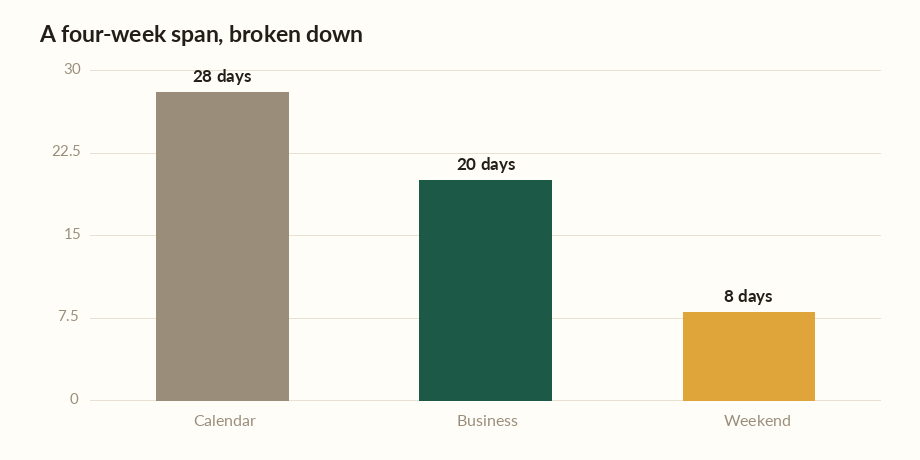
It walks through every date from your start to your end, both included, and checks the day of the week. Days that fall Monday through Friday count as business days; Saturdays and Sundays are tallied separately as weekend days. Four calendar weeks, for example, contain 28 days - 20 business days and 8 weekend days.
The calculation runs in your browser against your local calendar, so month lengths and leap years are handled automatically. If you enter the dates in the wrong order, the tool quietly swaps them so you still get a positive count.
Why business days differ from calendar days
Contracts, shipping estimates and payment terms are usually written in business days because offices are closed on weekends. "Net 30 business days" is noticeably longer than 30 calendar days once weekends pile up. This tool counts weekends but does not remove public holidays, which vary by employer and country.
For U.S. federal holidays that many businesses observe, the Office of Personnel Management publishes the yearly list at opm.gov, and a plain-language overview is at usa.gov. Subtract any holidays that land on a weekday inside your range for the true working-day count.
Planning projects and deadlines in working days
Most professional timelines run on working days, not calendar days, and mixing the two is a common source of missed deadlines. A vendor who promises delivery in ten business days is really describing two full working weeks, which - depending on where in the week you start - can stretch across two or even three calendar weekends. Counting explicitly removes that ambiguity.
The same logic applies to payroll cut-offs, court filing windows, return policies and service-level agreements, which are frequently written in business days precisely because offices are closed at weekends. When a contract says a response is due within a set number of business days, this calculator lets you find the exact deadline date rather than guessing and hoping.
One caveat worth repeating: this tool subtracts weekends but not holidays. A week containing a public holiday has one fewer working day than the raw count suggests, so for anything time-sensitive, cross-check the holiday calendar and adjust. For a rough plan, the weekend-only count is usually close enough; for a legal or contractual deadline, always confirm the holidays that apply to you.
Frequently asked questions
How does the business days calculator count?
It counts every Monday-through-Friday date between your start and end dates, including both endpoints, and reports that as business days alongside the calendar and weekend totals.
Are holidays excluded?
No. This calculator removes weekends only. Public holidays vary by country and employer, so subtract any that fall on a weekday within your date range.
Are both the start and end dates included?
Yes. The count is inclusive of both dates. A single weekday entered as both start and end counts as one business day.
What if I enter the dates backwards?
The calculator automatically swaps them so the result is always a positive number of days. Order does not matter.
How many business days are in a typical month?
Most months have 20 to 23 business days depending on how weekends fall and the number of calendar days. Enter the first and last day of a month to check any specific one.
Just need the total gap or a countdown? See the date duration calculator and days until calculator, or all our everyday calculators.