
Debt to Income Ratio Calculator
Enter your total monthly debt payments and your gross monthly income to find your debt-to-income ratio. This debt to income ratio calculator shows the percentage lenders use to judge new applications – calculated in your browser, with nothing saved.
Your debt-to-income ratio
How the debt to income ratio calculator works
Your debt-to-income ratio, or DTI, is the share of your gross monthly income that goes to debt payments. This debt to income ratio calculator divides your total monthly debt - loan, card, and housing payments - by your gross monthly income, then multiplies by 100 to get a percentage. Lenders lean on this single number to gauge how much new debt you can handle.
Estimates for general information only; not financial advice. Lenders may define which debts and income count differently, so your official DTI can vary.
A worked example
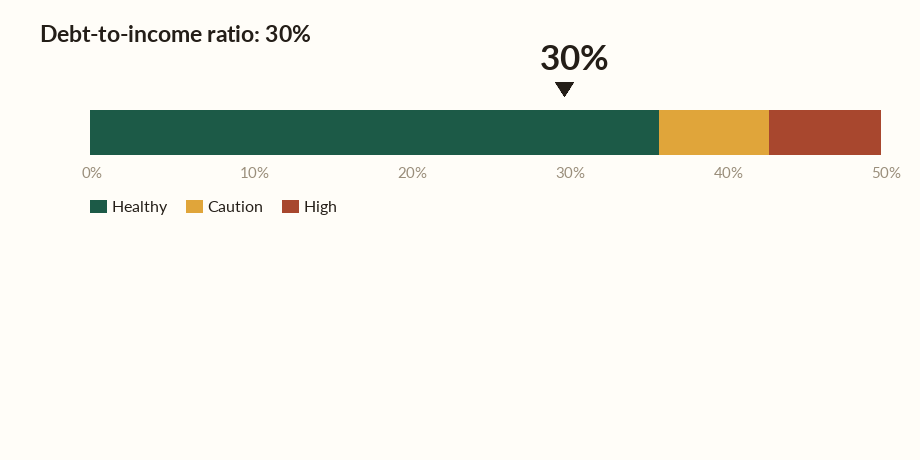
Suppose your monthly debt payments add up to $1,800 - a car loan, minimum card payments, and a student loan - and your gross monthly income is $6,000. Dividing $1,800 by $6,000 gives 0.30, or a 30% DTI.
At 30%, you sit in the range most lenders consider manageable. Many mortgage programs look for a DTI at or below 36%, with some allowing more; the lower your ratio, the more comfortably you can take on or pay down debt. Front-end DTI, which counts only housing costs, and back-end DTI, which counts all recurring monthly debt, are both used by lenders; this debt to income ratio calculator gives the broader back-end figure that most mortgage underwriting relies on when sizing a new loan.
What is a good debt-to-income ratio?
As a rough guide, a DTI under 36% is usually healthy, 36% to 43% calls for caution, and above 43% can make new borrowing difficult. Two levers move it: lower your monthly debt payments or raise your income. Paying down balances is often the fastest way to improve the ratio. Refinancing to a lower payment, consolidating high-rate balances, or simply avoiding new loans for a few months can also nudge the number down without any change in income.
The Consumer Financial Protection Bureau explains how lenders use DTI and why 43% is a common ceiling, and the Federal Trade Commission offers guidance on reducing debt. Lowering your ratio widens your options and usually earns better rates.
Working on the debt side? Use the free Debt Payoff Spreadsheet or our debt and loan calculators to bring those payments down.
Frequently asked questions
What counts as debt for DTI?
Recurring monthly obligations: mortgage or rent, auto and student loans, minimum credit card payments, and similar. Utilities and groceries are usually excluded.
Should I use gross or net income?
Lenders typically use gross (pre-tax) monthly income for DTI, which is what this calculator expects. Using net income would overstate your ratio.
What DTI do lenders want?
It varies by loan, but many look for 36% or below, and 43% is a common upper limit for qualified mortgages. Lower is always better.
How can I lower my DTI quickly?
Pay down high-balance debts, avoid taking on new loans, and increase income where you can. Even clearing one small payment can move the number.
Does DTI affect my credit score?
DTI itself is not in your credit score, but the balances behind it affect credit utilization, which is. Lowering debt helps both.
Ready to lower your ratio? Explore our debt and loan calculators or start with the debt payoff calculator.