
Debt Snowball Calculator
List your debts – balance, rate, and minimum for each – plus any extra you can add. This debt snowball calculator orders them smallest balance first, rolls each finished payment into the next debt, and shows when you will be debt-free. Everything runs in your browser, with nothing saved.
Your debt snowball plan
How the debt snowball calculator works
The snowball method pays the minimum on every debt, then throws all your spare cash at the smallest balance. When that debt is gone, its payment rolls onto the next-smallest, and so on - each payoff makes the next one faster. This debt snowball calculator simulates that month by month: it adds interest, pays every minimum, and directs the remainder to the smallest remaining balance until all are clear.
Estimates for general information only; not financial or tax advice. Your actual minimums and rates may change over time.
A worked example
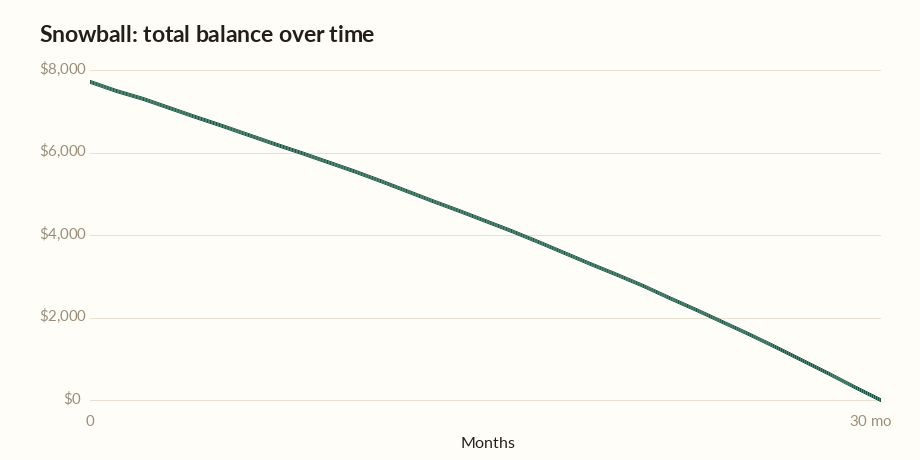
Suppose you have three debts: $1,200 at 12%, $2,500 at 19%, and $4,000 at 25%, with minimums of $35, $65, and $90, and $150 extra to spend. The snowball attacks the $1,200 first, then the $2,500, then the $4,000.
With a steady $340 total each month, all three clear in about 30 months, costing roughly $2,491 in interest. The quick early win - erasing the $1,200 debt in just a few months - is what keeps many people motivated to finish the whole plan. That momentum is the whole point of the method: watching a balance disappear early makes the longer road ahead feel achievable, and it builds the habit of throwing every spare dollar at debt.
Snowball vs avalanche
The snowball orders debts by balance; the avalanche orders them by interest rate, targeting the most expensive first. Avalanche usually saves a little more interest, while the snowball delivers faster psychological wins. For the example above, avalanche would save around $440 - real money, but for many people the momentum of the snowball is worth the small difference.
The Federal Trade Commission describes both approaches to getting out of debt, and the Consumer Financial Protection Bureau explains when consolidating balances might help too. The best method is the one you will actually stick with month after month.
Prefer the math-optimal route? Try our debt avalanche calculator, grab the free Debt Payoff Spreadsheet, or explore all our debt and loan calculators.
Frequently asked questions
What is the debt snowball method?
You pay minimums on everything, then put every spare dollar toward your smallest balance. Once it is gone, that payment rolls to the next-smallest debt, building momentum as you go.
Does the snowball save the most money?
Not usually - the avalanche method, which targets the highest rate first, typically saves a bit more interest. The snowball wins on motivation with faster early payoffs.
What is the extra payment?
It is any amount above your combined minimums that you can devote to debt each month. The larger it is, the faster every method clears your balances.
Can I add more than three debts?
Yes. Enter each debt’s balance, rate, and minimum, and leave unused rows blank. The calculator handles them together.
Does the order really matter?
It changes which debt clears first and the total interest, but paying consistently matters far more than the exact order. Pick the method you will follow.
Compare methods with our debt avalanche calculator or see everything in our debt and loan calculators.