
Interest Savings Calculator
Compare two monthly payment amounts on the same balance. This interest savings calculator shows how much interest and how many months you save by paying more each month – all in your browser, with nothing saved.
Interest you save by paying more
How the interest savings calculator works
The interest savings calculator amortizes your balance at two payment levels – your current payment and a higher one – and compares the totals. For each, it adds monthly interest, subtracts the payment, and repeats until the balance is gone, tracking the interest paid along the way. The gap between the two interest totals is your savings.
Estimates for general information only; not financial or tax advice. Daily compounding and fees at your lender may shift the exact numbers.
A worked example
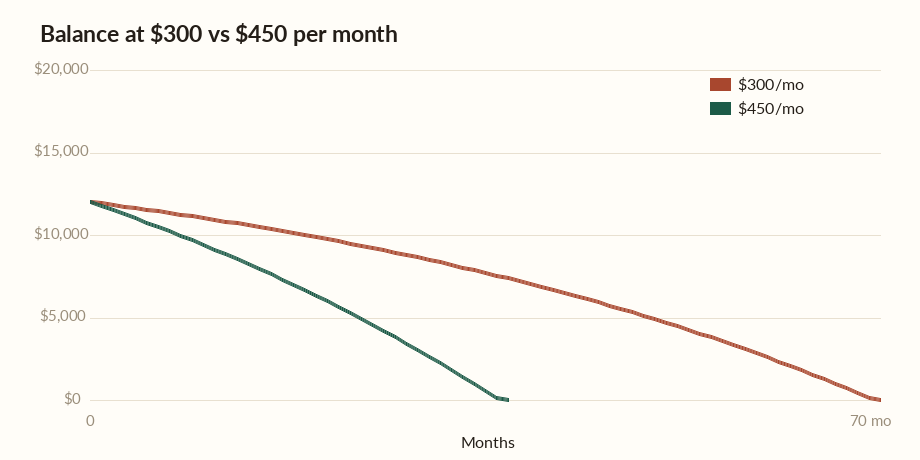
Suppose you owe $12,000 at 21% APR. At $300 a month, payoff takes about 70 months and roughly $8,820 in interest. That is a long, expensive road at a high rate.
Raise the payment to $450 a month and the balance clears in about 37 months with around $4,306 in interest. Paying $150 more each month saves about $4,514 in interest and 33 months of payments – more than half the interest, gone. The same balance and the same rate – only the monthly payment changed, yet the total cost dropped by thousands of dollars over the life of the debt, which is why a higher payment is one of the most reliable ways to save.
How to save the most interest
The biggest savings come from raising your payment, lowering your rate, or both. Because interest accrues on the remaining balance, a higher payment cuts the balance faster and shrinks every future interest charge. A lower APR – through a balance transfer or refinance – attacks the same problem from the other side. Making biweekly half-payments is a third lever: it slips in roughly one extra payment each year without straining your budget, quietly trimming both months and interest off the balance you carry.
The Consumer Financial Protection Bureau explains exactly how card interest is calculated, and the Federal Trade Commission lists proven ways to get out of debt. Combining a higher payment with a lower rate saves the most.
To weigh several balances together, use the free Debt Payoff Spreadsheet or browse our debt and loan calculators.
Frequently asked questions
How is interest saved calculated?
The tool subtracts the interest paid at the higher payment from the interest paid at the lower payment. The difference is what you keep by paying more each month.
Why does a small increase save so much?
Extra money goes entirely to principal, which lowers every future interest charge. On a high-rate balance those savings compound quickly.
Does a lower interest rate help too?
Yes, a lot. A lower APR reduces the interest added each month. Try a balance-transfer or refinance rate in the calculator to see the effect.
Is this the same as an extra payment calculator?
They are close cousins. This one compares two full payment amounts; our extra payment calculator adds a set extra to your current payment. Both show the interest you save.
Can I trust these numbers exactly?
They are solid estimates using standard monthly compounding. Your lender’s daily compounding, fees, or billing dates may move the totals slightly.
See the full toolkit in our debt and loan calculators, or start with the debt payoff calculator.