
Extra Payment Calculator
Enter your balance, interest rate, current payment, and any extra you could add each month. This extra payment calculator shows how many months and how much interest that extra cash saves you – calculated in your browser, with nothing saved.
What an extra payment saves
How the extra payment calculator works
The extra payment calculator runs your balance twice: once at your current monthly payment, and once with your extra amount added on top. Each run adds interest and subtracts the payment month after month until the balance clears, then compares the two payoff dates and interest totals. Every extra dollar goes straight to principal, so it stops accruing interest for the rest of the loan.
Estimates for general information only; not financial or tax advice. Your lender’s exact compounding and fees may change the figures slightly.
A worked example
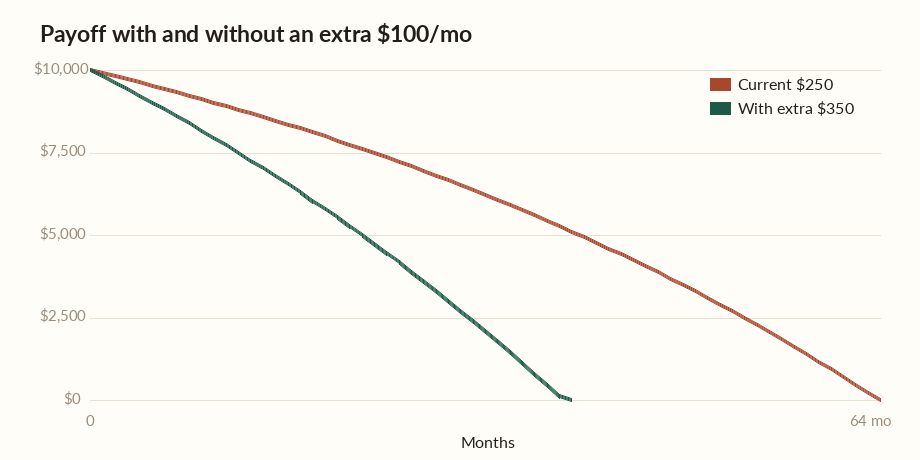
Take a $10,000 balance at 19% APR. Paying $250 a month, you would be debt-free in 64 months after about $5,967 in interest. Add just $100 a month – $350 total – and the picture changes sharply.
With the extra payment, the balance clears in 39 months with roughly $3,417 in interest. That single change saves 25 months and about $2,550 in interest, all from an extra $100 you were able to find each month.
Why a little extra goes so far
Extra payments are powerful because interest is charged on the balance that remains. Knock the balance down faster and every future month’s interest is smaller, which frees up even more of your next payment for principal – a snowball that builds on itself. On a $10,000 balance, the gap between a 64-month grind and a 39-month payoff is real money staying in your pocket, and that effect grows with both the size of your balance and the height of your interest rate.
The Consumer Financial Protection Bureau shows how paying more than the minimum shrinks a multi-year payoff, and the Federal Trade Commission outlines broader strategies for getting out of debt. Even irregular extra payments – a tax refund or a bonus – shave time and interest off the total.
Want to see the whole plan? Pair this with the free Debt Payoff Spreadsheet or our other debt and loan calculators.
Frequently asked questions
Does the extra payment have to be the same every month?
No. Even occasional extra payments help, though the calculator assumes a steady extra amount so it can show a clear before-and-after. Any additional principal you pay reduces future interest.
Where should my extra payment go?
Ask your lender to apply extra amounts to principal, not to next month’s payment. Applying it to principal is what shortens the loan and cuts interest.
Is it better to save or pay extra?
It depends on your rate. On high-interest debt, extra payments often beat the return on savings, but keeping a small emergency fund first is usually wise. This tool is informational, not personalized advice.
Will paying extra hurt my credit?
No. Paying down balances typically lowers your credit utilization, which can help your score. Just confirm there is no prepayment penalty on your loan.
Can I use this for any debt?
Yes, for any single fixed-rate balance. For several debts at once, the snowball and avalanche calculators show where an extra payment does the most good.
Explore all our debt and loan calculators or start with the debt payoff calculator.