
Credit Card Payoff Calculator
Enter your card balance, its APR, and the amount you pay each month. This credit card payoff calculator shows how many months until the balance reaches zero and how much interest you will pay to get there – all in your browser, with nothing saved.
Your card payoff plan
How the credit card payoff calculator works
Each month, your card adds interest to the balance, then subtracts the payment you make. This credit card payoff calculator repeats that cycle - add interest, subtract payment - until the balance hits zero, and reports the month you become debt-free. Because interest is charged on whatever balance remains, a higher APR or a smaller payment means more of your money goes to interest instead of principal.
Estimates for general information only; not financial or tax advice. Your card may compound interest daily and apply fees, so real figures can vary with your issuer’s terms.
A worked example
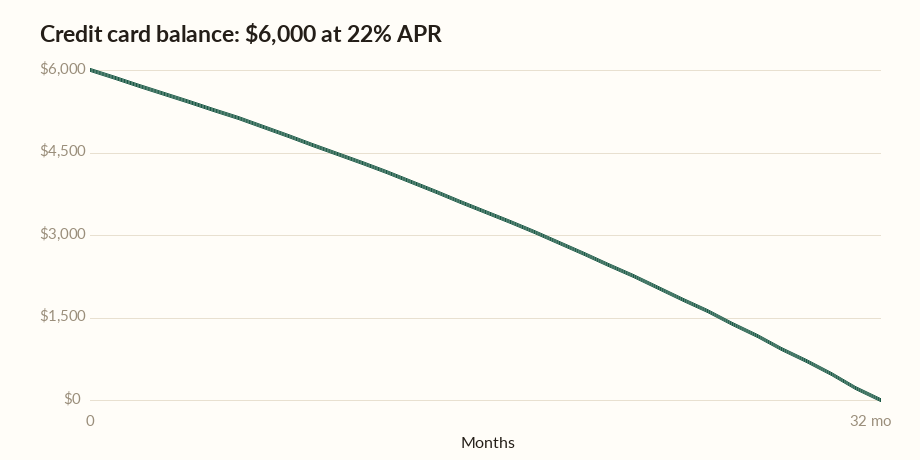
Say you owe $6,000 on a card at 22% APR and pay $250 a month. The first month’s interest is about $110, so roughly $140 of your payment reduces the principal. As the balance shrinks, the interest portion falls and more of each payment attacks the principal, so the balance drops faster over time.
The result: debt-free in 32 months, having paid about $1,979 in interest - $7,979 in total. Raising the monthly payment even a little shortens that timeline and cuts the interest noticeably; try different amounts in the calculator above to see your own numbers.
How to pay off credit card debt faster
Three levers move your payoff date earlier: pay more than the minimum each month, lower your APR, and stop adding new charges while you clear the balance. Because credit card interest compounds on the remaining balance, even a modest increase in your payment has an outsized effect - more of every dollar lands on principal.
The Consumer Financial Protection Bureau explains how issuers calculate the interest you owe, and the Federal Trade Commission outlines proven ways to get out of debt, including the snowball method (smallest balance first) and the avalanche method (highest rate first). A low-rate balance transfer can also cut the interest you pay while you focus on principal.
Juggling more than one card? Grab the free Debt Payoff Spreadsheet or explore all our debt and loan calculators - then use this credit card payoff calculator to double-check any single balance.
Frequently asked questions
Is APR the same as the interest rate?
For most credit cards, yes - the APR is the yearly interest rate the calculator uses. It divides that figure by 12 to get the monthly rate, which matches how card interest typically accrues.
Why is so much of my payment going to interest?
Early on, interest is charged on a large balance, so a big share of each payment covers interest before it touches principal. As the balance falls, that flips, and more of every payment reduces what you owe.
What if I only pay the minimum?
Minimum-only payments can stretch a card balance over many years and multiply the interest. Our minimum payment calculator shows how long that takes; paying a fixed amount above the minimum is far faster.
Does this include new purchases?
No. The calculator assumes you stop adding charges and pay down the balance you enter. New purchases would raise the balance and push your payoff date back.
Is this the snowball or avalanche method?
This tool handles one balance at a time. To order several debts by snowball or avalanche, use our free debt payoff spreadsheet or the dedicated snowball and avalanche calculators.
Ready to plan the whole picture? Explore our debt and loan calculators or start with the debt payoff calculator.