
Knitting Gauge Calculator
The knitting gauge calculator converts a stockinette swatch into the cast-on stitches and row count you need. Enter the stitches and rows in your swatch and your finished measurements, and it does the math for a perfect-size project.
Match your pattern gauge
How the knitting gauge calculator works
Gauge, sometimes called tension, is the number of stitches and rows that fit into four inches of knitted fabric. The knitting gauge calculator divides your swatch stitches by its width to find stitches per inch, then multiplies by four to give the stitches-per-4-inches value that patterns list.
It then multiplies your stitches per inch by your target width to find how many stitches to cast on, and multiplies rows per inch by your target length to find the total rows. Because every knitter works at a slightly different tension, matching gauge with a swatch is the only reliable way to hit a pattern’s finished size.
Worked example
Say your stockinette swatch measures 20 stitches across 4 inches and 28 rows over 4 inches. That works out to 5 stitches per inch and 7 rows per inch, a common worsted-weight gauge.
For a scarf 20 inches wide and 24 inches long, multiply 5 stitches per inch by 20 to cast on 100 stitches, and 7 rows per inch by 24 to knit about 168 rows. If your swatch is off, change needle size and swatch again. A quick re-swatch takes only a few minutes and can save hours of unraveling a garment that turned out the wrong size.
Getting an accurate knitting gauge calculator result
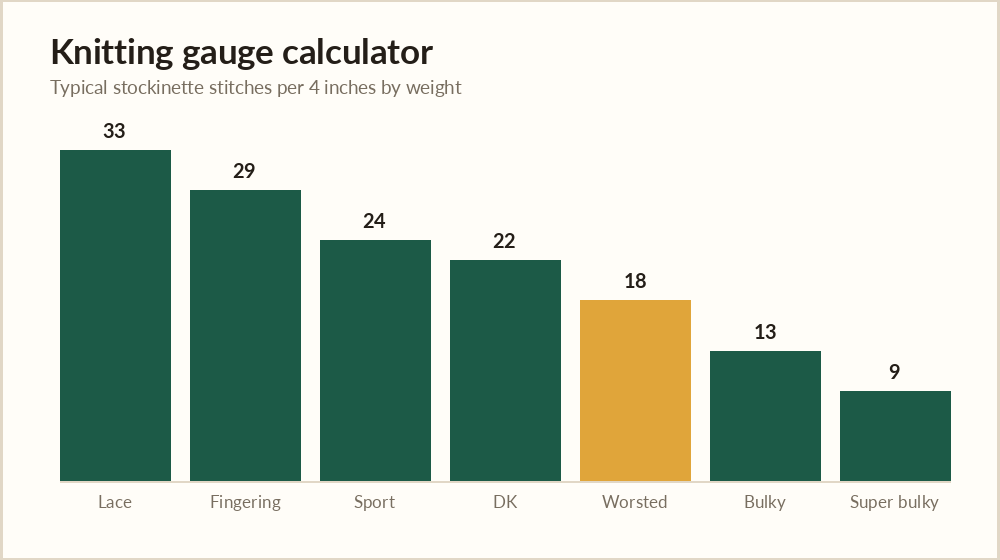
Knit your swatch in the round if the project is worked in the round, since flat and circular tension can differ. Too many stitches per inch means your knitting is tight, so move up a needle size; too few means it is loose, so move down. The Craft Yarn Council weight system lists a suggested stockinette gauge for each yarn weight.
Wash and block the swatch exactly as you will treat the garment, then let it dry flat before measuring, because blocking can open up the fabric and change the count. Count across the widest flat section, away from the cast-on and the side edges. For background, see this overview of knitting gauge.
Related calculators: All craft calculators · Crochet Gauge Calculator · WPI Yarn Weight Calculator
Frequently asked questions
What is gauge in knitting?
Gauge, or tension, is how many stitches and rows fit into a set measurement, usually four inches of stockinette. Matching it to the pattern is what makes a knitted garment come out the right size.
How many stitches should I cast on?
Multiply your stitches per inch by the finished width you want. At 5 stitches per inch, a 20 inch piece needs 100 stitches. This calculator does that math from your swatch automatically.
Should I swatch in the round or flat?
Match your project. Many knitters have a different tension in the round than flat, so if the garment is worked in the round, knit and measure your swatch the same way for accurate numbers.
My gauge is off – what do I change?
Change needle size, not the yarn. Too many stitches per inch means the fabric is too tight, so go up a needle size; too few means it is loose, so go down a size, then re-swatch to confirm.
Does row gauge matter?
It matters most for anything measured in rows rather than length, such as raglan shaping or colorwork motifs. For simple length-based pieces you can knit to a measurement, but matching row gauge keeps shaped patterns proportional.