
Crochet Yarn Calculator
The crochet yarn calculator estimates how much yarn your next project needs. Enter the finished width and length, choose your yarn weight, and it returns the total yards, meters, and the number of skeins to buy – with a 10% buffer already built in so you don’t run short.
How much yarn does your project need?
How the crochet yarn calculator works
Yarn use comes down to area. The crochet yarn calculator multiplies your project’s width by its length to get the surface area in square inches, then multiplies that by a yards-per-square-inch figure for your chosen yarn weight. Thinner yarns pack more stitches into each inch, so they need more yardage to cover the same area, while thicker yarns need less.
The tool uses single crochet as its baseline because it is the most common and densest basic stitch. It then adds a 10% margin for weaving in ends, tension changes, and swatching, and divides the total by your skein length to tell you how many skeins to buy. Openwork, granny squares, and tall stitches like double crochet use noticeably less yarn than the estimate, so treat the result as a safe upper bound.
Worked example
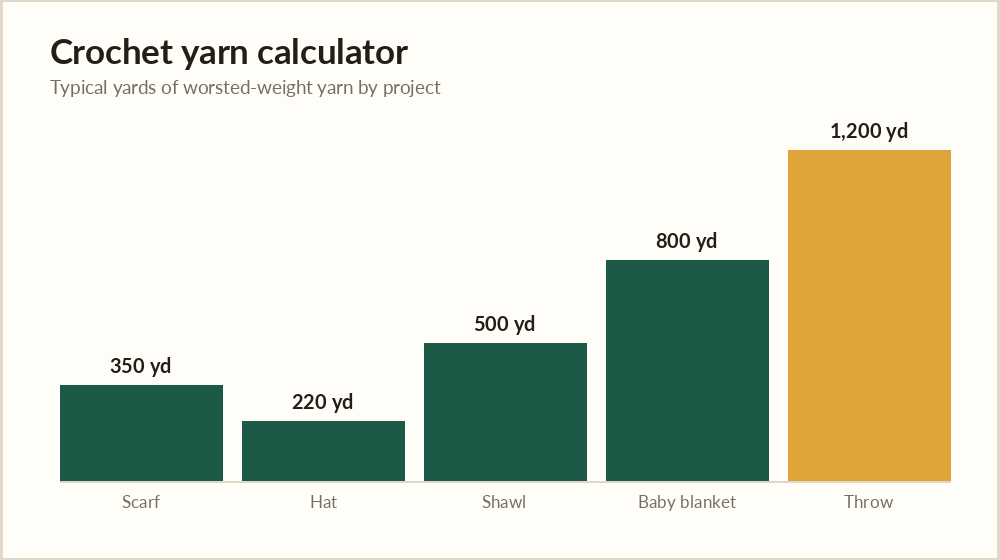
Say you are making a 40 by 50 inch throw in worsted-weight yarn, and each skein holds 220 yards. The area is 40 x 50 = 2,000 square inches. Worsted single crochet uses roughly 0.5 yards per square inch, so the base estimate is 1,000 yards.
Adding the 10% buffer brings it to 1,100 yards, or about 1,006 meters. Divided by 220 yards per skein and rounded up, that is 5 skeins. Buying all five from the same dye lot keeps the color consistent across the whole blanket.
Tips for a more accurate crochet yarn calculator estimate
Yarn weight is the biggest variable, so match it to the number printed on the yarn label. The Craft Yarn Council Standard Yarn Weight System groups yarn into eight categories from lace to jumbo, each with a typical gauge and hook size, and every commercial label carries that number.
Stitch choice matters almost as much as weight. Dense stitches like single crochet and tapestry crochet use yarn quickly, while lacy shawls and mesh use far less. When in doubt, crochet a small swatch, note how many yards it took, and scale up by area. For a broader primer on the craft, this overview of crochet is a useful starting point. Always buy a little extra from one dye lot to be safe.
Related calculators: All craft calculators · How Much Yarn Do I Need · Yarn Yardage Calculator
Frequently asked questions
How much yarn do I need for a crochet blanket?
A worsted-weight baby blanket runs about 800 to 1,200 yards, a lap throw 1,000 to 1,500 yards, and a full-size afghan 2,000 to 3,500 yards. Enter your exact dimensions above for a tailored number, and add one extra skein for borders and edging.
Does yarn weight change how much I need?
Yes, and significantly. Finer yarns need more yardage to cover the same area because each stitch is smaller. Switching from worsted to fingering can roughly double the yards required, while moving up to bulky can cut it by about a third.
How many yards are in a skein of yarn?
It varies by brand and weight. A common worsted skein holds about 200 to 220 yards, fingering skeins often hold 400 or more, and bulky skeins may hold only 100 to 150. Check your yarn label and enter that figure for an accurate skein count.
Should I buy extra yarn?
Always. This crochet yarn calculator already adds a 10% buffer, but buying one more skein from the same dye lot protects you against gauge differences, mistakes, and edging. Leftover yarn is also handy for repairs later.
Does stitch type affect yarn usage?
Very much so. Single crochet is dense and uses the most yarn, so it is the safe baseline here. Taller stitches like double and treble crochet, and open lace or mesh patterns, can use 20 to 40 percent less yarn for the same finished size.