
Paver Calculator
This free paver calculator shows how many pavers you need for a patio, walkway, or driveway. Enter the area and paver size to get the pavers to buy plus the gravel base.
How many pavers do you need?
How the paver calculator works
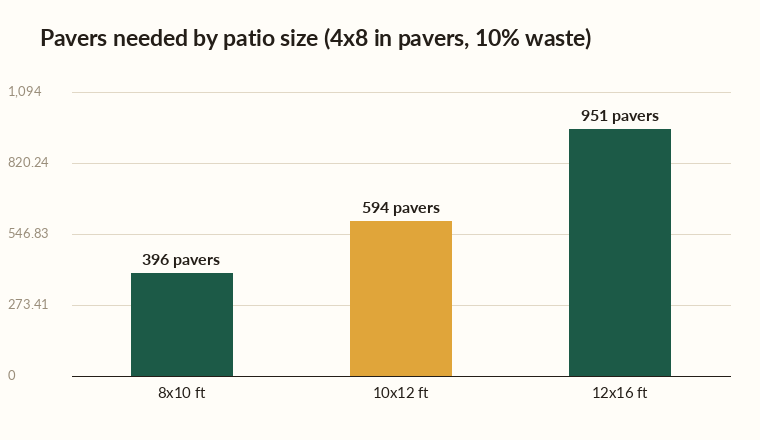
The paver calculator finds the patio area (length times width), works out how many pavers cover one square foot, adds a waste factor, and rounds up. Pavers per square foot is 144 divided by the paver length times width in inches – so a 4 by 8 inch paver covers 32 square inches and takes about 4.5 pavers per square foot. Multiply by the area, add 10% for cuts, and round up.
The calculator also estimates the compacted gravel base at a 4-inch depth, because pavers are only the top layer of a four-part system. A stable installation is built on a compacted aggregate base, a 1-inch bedding sand layer, the pavers, and polymeric joint sand swept between them. Skipping base depth or using the wrong sand is the top reason patios sink and shift.
Worked example
A 10 ft by 10 ft patio is 100 square feet. With 4 by 8 inch pavers at 4.5 per square foot, that is 450 pavers, and adding 10% waste brings it to about 495. The same patio needs roughly 1.2 cubic yards of gravel for a 4-inch base, plus about a cubic yard of sand split between bedding and joints. Order pavers by the pallet where possible.
Base, edge restraints, and patterns
Base depth depends on load: 4 inches of compacted gravel for a patio or walkway, and 6 to 8 inches for a driveway. Edge restraints are required around the whole perimeter – without them, pavers spread outward under foot traffic and freeze-thaw cycles. Pattern also affects waste: running bond and basketweave waste about 5%, while a 45-degree herringbone can reach 10% from angled edge cuts.
For installation standards, the Concrete Masonry & Hardscapes Association (which absorbed the Interlocking Concrete Pavement Institute) publishes the base, bedding, and edge-restraint specs, and the USGS covers the aggregates used in the base.
Measuring tips
Break irregular patios into rectangles and add the areas, then account for borders and soldier courses separately since they use a different paver size. Lay geotextile fabric between the soil and gravel to stop the base from sinking into the subgrade, and confirm the paver module – length, width, and joint gap – against your supplier before ordering.
Frequently asked questions
How many pavers do I need?
Enter the patio length and width and the paver size, plus a waste factor. The calculator returns the pavers to buy. A 10 by 10 patio with 4 by 8 inch pavers needs about 495 pavers including waste.
How many 4×8 pavers are in a square foot?
About 4.5. A 4 by 8 inch paver covers 32 square inches, and 144 divided by 32 is 4.5 pavers per square foot before waste and joint spacing.
How much gravel base do I need under pavers?
Use 4 inches of compacted gravel for patios and walkways and 6 to 8 inches for driveways. A 100-square-foot patio needs about 1.2 cubic yards of gravel for a 4-inch base.
What waste factor should I use for pavers?
Use about 5% for running bond or basketweave and up to 10% for herringbone or areas with lots of curves and edge cuts. Borders and inlays should be counted separately.
Do I need edge restraints for pavers?
Yes. Edge restraints are required around the entire perimeter. Without them, pavers spread outward over time under traffic and freeze-thaw movement, causing gaps and shifting.