
Wallpaper Calculator
This free wallpaper calculator estimates how many rolls you need for a room. Enter the length, width, wall height, and a waste allowance for pattern matching to get the rolls to buy.
How many rolls of wallpaper?
How the wallpaper calculator works
The wallpaper calculator measures the wall area – twice the room length plus twice the width, multiplied by the wall height – then adds a waste allowance for pattern matching and trimming and divides by the usable coverage of one roll. A US single roll holds about 56 square feet of paper, but after cutting each strip to height and lining up the pattern, only about 25 to 32 square feet is usable, so the calculator uses the usable figure rather than the printed one.
The waste percentage is the input people most often get wrong. Plain or random-match paper wastes little, so 10% is enough; a pattern with a 12- to 24-inch repeat can push waste to 15 to 20% because every strip must be aligned to its neighbor. Enter the repeat listed on your wallpaper label to pick the right number.
Worked example
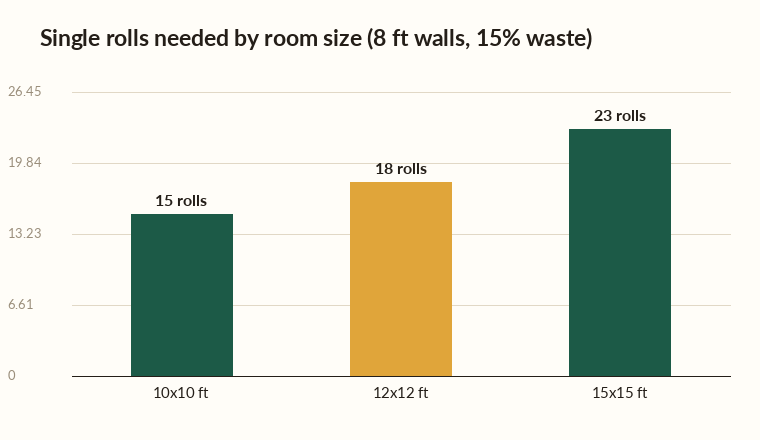
A 12 ft by 12 ft room with 8-foot walls has 384 square feet of wall (a 48-foot perimeter × 8 feet). Adding 15% for a modest pattern repeat brings it to about 442 square feet. At 25 usable square feet per single roll that is roughly 18 rolls, or 9 double rolls. Rounding up and buying from a single batch keeps the color consistent across the room.
Pattern repeat, batches, and prep
Two details save most wallpaper projects. First, always order every roll from the same run or lot number – printing batches vary slightly in color, and a mismatch shows on the wall. Second, do not subtract small doors and windows; leaving them in the area gives the buffer you need for cutting and future repairs. Buy one extra roll and keep it with the lot number recorded.
Good preparation matters as much as the count. Strip old paper, fill and sand the wall, and prime so seams do not show. If your home was built before 1978, scraping old wallpaper and paint can disturb lead – the US EPA explains lead-safe work practices, and this wallpaper methodology reference details how pattern repeat changes the roll count.
Measuring tips
Measure each wall and add the widths together, since paper wraps around corners. Convert the pattern repeat to the same units as your height, and if ceilings are uneven, cut and number each drop separately. When your result lands close to a whole number, round up – an extra roll is far cheaper than a mid-project shortage in a discontinued print.
Frequently asked questions
How many rolls of wallpaper do I need?
Enter the room length, width, and wall height, plus the usable coverage per roll and a waste percentage. The calculator returns the rolls to buy. A 12 by 12 room with 8-foot walls needs roughly 18 single rolls.
How much wallpaper is in a roll?
A US single roll holds about 56 square feet of paper but only about 25 to 32 square feet is usable after cutting to height and matching the pattern. Rolls are usually sold in double-roll packages.
How much extra should I add for pattern repeat?
Use about 10% waste for plain or random-match paper and 15 to 20% for patterns with a 12- to 24-inch repeat, since each strip must line up with the last.
Should I subtract doors and windows?
For wallpaper, no. Leaving small openings in the area gives you the buffer needed for cutting, pattern matching, and repairs. Only subtract full floor-to-ceiling openings.
Why buy wallpaper from the same batch?
Printing runs vary slightly in color. Ordering every roll from one lot or run number – and one extra for repairs – keeps the color consistent across the wall.