
Puppy Weight Calculator
Wondering how big your puppy will grow? Enter the current weight, age in weeks, and size group to estimate the adult weight, plus a realistic range to plan for.
How big will your puppy get?
How the puppy weight calculator works
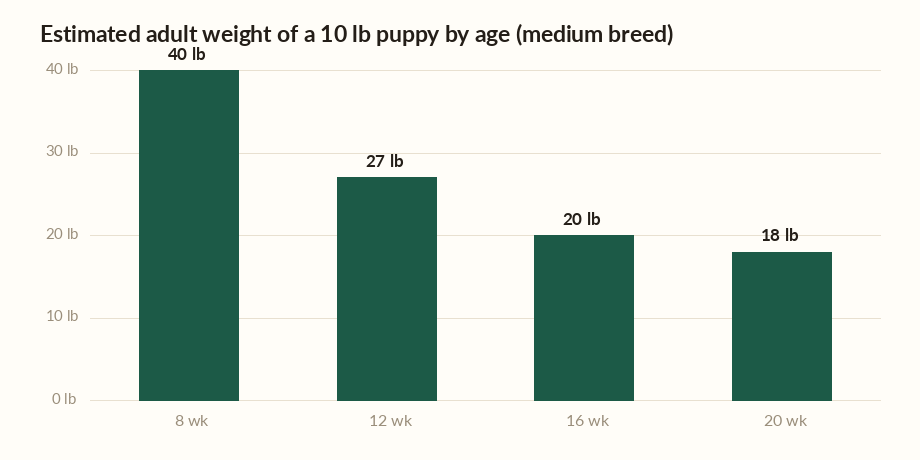
Puppies do not grow in a straight line - they climb steeply for the first few months, then taper toward maturity. This puppy weight calculator estimates what fraction of adult weight a puppy has reached at its current age, based on its size group, then scales the current weight up to a full-grown figure.
Smaller breeds finish growing sooner (often 8 to 12 months), while large and giant breeds keep growing for 15 to 24 months. That is why the tool asks for a size group: a 20-week giant-breed puppy still has far more growing to do than a small-breed one.
A simpler formula you can check
A popular quick estimate is: adult weight = (current weight / current age in weeks) x 52. As Dutch's veterinary team notes, this assumes steady growth to one year and works best for small and medium dogs. Our size-aware method refines it so large breeds are not underestimated.
Another cross-check: small breeds often reach about four times their 6-week weight, and medium or large breeds about 2.5 times their 14-week weight. Running a couple of methods gives you a sensible range rather than one shaky number.
What affects a puppy grown size
Breed, parentage, sex, nutrition, and neuter timing all shape final size, and males usually finish a little larger than females. A balanced puppy diet supports healthy growth without pushing weight too fast, which matters for joints in large breeds.
Paw size relative to the body is a loose hint that more growth is coming. For the clearest picture, compare your puppy's growth curve against a breed-appropriate chart with your veterinarian.
When puppies stop growing
Small and toy breeds usually reach their adult weight by 8 to 12 months, medium breeds around 12 to 14 months, and large breeds by roughly 15 months. Giant breeds are the slow finishers, sometimes filling out their frames until 18 to 24 months.
Height tends to finish before weight - a lanky adolescent dog may still add muscle and chest depth after it stops getting taller. If growth seems to stall very early or race ahead of the breed norm, a quick weight check with your veterinarian can rule out nutritional or health issues.
Frequently asked questions
How do I estimate my puppy adult weight?
Estimate what share of adult weight the puppy has reached for its size and age, then scale up. A common shortcut is current weight divided by age in weeks, times 52.
At what age is a puppy weight estimate most accurate?
Between about 12 and 20 weeks. Very young puppies grow unpredictably, and by adulthood the estimate no longer matters.
How big will my medium-breed puppy get?
A medium puppy is roughly half its adult weight around 16 weeks, so doubling the 16-week weight gives a fair starting estimate.
Do large breeds grow for longer?
Yes. Large breeds often grow to 15 months and giant breeds up to about two years, so they weigh a smaller share of their adult size at any given age.
Are male and female puppies different sizes?
Usually. Males tend to finish somewhat heavier than females of the same breed, though there is plenty of overlap.
Is the puppy weight calculator exact?
No. It is a guided estimate. Genetics, breed mix, and nutrition all shift the final weight, so use the range and confirm with your vet.
Feeding a growing pup? See the dog food calculator, or explore all pet calculators.