
Dog Age Calculator
Dogs pack a lot of living into every year, and how fast they age depends heavily on their size. Enter an age and pick a size group to see a realistic human-year equivalent – far more useful than the old rule of multiplying by seven.
Your dog’s age in human years
How the dog age calculator works
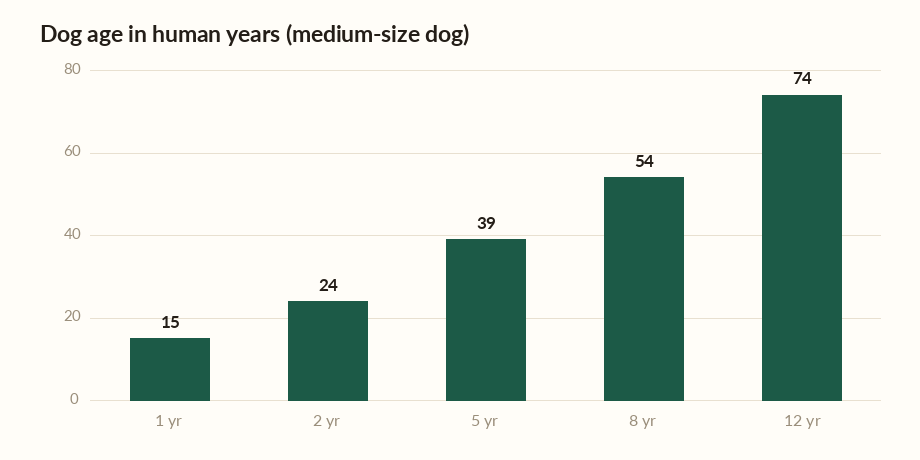
Veterinary groups no longer treat every dog year as a flat block of human years. The widely used AKC and AVMA guideline counts a dog's first year as about 15 human years, the second year as roughly 9 more (reaching about 24), and every year after that as 4 to 7 human years depending on size.
This dog age calculator applies that curve and adjusts the yearly step by size: about 4 human years per year for small breeds, 5 for medium, 6 for large, and 7 for giant breeds. That is why a 10-year-old small dog lands near 56 while a giant breed of the same age is closer to 80.
Why the 7-year rule is a myth
The idea that one dog year equals seven human years likely came from dividing an average human lifespan of about 70 by an average dog lifespan of about 10. As the American Kennel Club notes, it is memorable but inaccurate: a one-year-old dog is already fully grown and sexually mature, closer to a mid-teen human than a seven-year-old child.
Does size really change how dogs age?
Yes. Smaller dogs tend to live longer and age more slowly late in life, while large and giant breeds age faster and often reach their senior years by five or six. A study at the UC Davis veterinary school even mapped a dog's DNA to build a scientific formula, though it was based on Labradors and does not yet cover every breed.
Because breed, weight, and health all matter, treat the number here as a friendly estimate rather than a medical readout. Your veterinarian can assess your dog's true life stage from teeth, joints, and bloodwork.
Frequently asked questions
How do I calculate my dog age in human years?
Count the first year as 15 human years, add about 9 for the second year, then add 4 to 7 for each additional year based on your dog's size. This dog age calculator does that math for you.
Is one dog year really seven human years?
No. The 7-year rule is an outdated approximation. Dogs age very quickly in their first two years and more slowly afterward, so the true rate is not a straight multiple.
When is a dog considered a senior?
Small dogs are often called senior around seven years, while large and giant breeds may reach senior status at five to six years because they have shorter lifespans.
Why does breed size change the result?
Larger dogs mature and age faster than smaller dogs, so each calendar year adds more human-equivalent years for a giant breed than for a toy breed.
How accurate is a dog age calculator?
It gives a solid general estimate, but individual breed, genetics, weight, and health can shift the real figure. Use it for context, not diagnosis.
Does this work for puppies under one year?
Roughly. Below one year the tool scales linearly toward 15 human years, but puppies develop in bursts, so early estimates are approximate.
Want to compare methods? Try our dog years calculator, or explore the full set of pet calculators.