
Lease vs Buy Calculator
Deciding whether to lease or buy your next car comes down to the total cost over the time you will actually drive it. This lease vs buy calculator compares the full cost of leasing against the net cost of buying – after you sell the car at the end – so you can see which is genuinely cheaper. Everything runs in your browser and nothing is saved.
Lease vs buy this car
How the lease vs buy calculator works
The lease vs buy calculator totals two costs and puts them side by side. For leasing, it adds your amount due at signing to every monthly lease payment across the term. For buying, it finances the price minus your down payment at the loan APR you enter, adds the down payment back in, then subtracts the resale value you keep at the end. Because a car you buy is still worth something later, that resale value is real money returned to you, which is why buying is compared on a net basis.
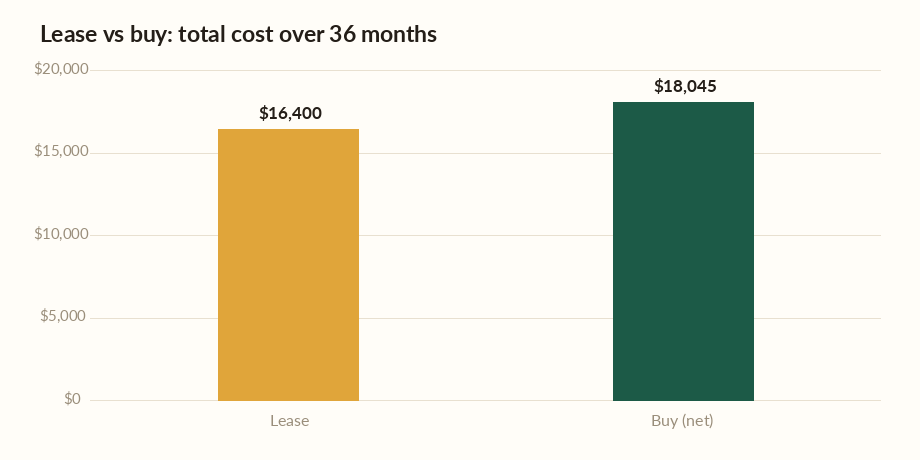
Take the default numbers over a 36 month term: leasing costs about 16,400 dollars in total, while buying nets out near 18,045 dollars after you sell the car for 20,000 dollars. Leasing looks roughly 1,645 dollars cheaper here, but buying leaves you owning an asset you can keep driving payment-free, so the gap usually reverses the longer you hold the car.
Lease vs buy: which is cheaper?
Leasing tends to win on short horizons and low monthly outlay: payments are smaller, you drive a newer car, and you hand it back at the end. The trade-offs are that the payments never stop, mileage is capped, and wear-and-tear charges can apply. Buying costs more in the early years but you build equity, and once the loan is paid off you can drive for years with no monthly payment at all.
The right answer depends on how long you keep a car, how many miles you drive, and how you feel about always having a payment. The Federal Trade Commission explains the key differences in its guide on financing or leasing a car, and the Consumer Financial Protection Bureau breaks down the differences between leasing and buying in plain language.
Tips to get a better deal
Negotiate the price of the car first, before you talk monthly payments or a lease. On a lease the negotiated price is the capitalized cost, and a lower cap cost lowers every payment. Watch the money factor, which is the lease equivalent of an interest rate, and avoid stretching a purchase loan to 72 or 84 months just to shrink the payment.
Always compare on total cost, not the monthly figure a salesperson leads with. Two deals with the same monthly payment can differ by thousands once you add up the term, the money down, and the value left at the end. Depreciation is the single largest cost of owning most cars, so a model that holds its value well can be cheaper to buy even at a higher sticker.
Frequently asked questions
Is it cheaper to lease or buy a car?
Over a short term with low mileage, leasing often has a lower total cost and a smaller monthly payment. Over the long run, buying is usually cheaper because you eventually own the car and can drive it with no payment. Enter your own numbers above to see which wins for your situation.
What is a good lease term?
Most leases run 24 to 39 months, with 36 months being the most common. Shorter terms keep you in warranty and out of higher-maintenance years, while longer terms lower the monthly payment but keep you paying for an older car.
Does buying a car build equity?
Yes. Each loan payment increases the share of the car you own, and once it is paid off the resale value is entirely yours. Leasing builds no equity because you return the car at the end of the term.
What mileage limits apply to a lease?
Standard leases cap annual mileage, often around 10,000 to 15,000 miles per year, and charge a per-mile fee for anything over. If you drive a lot, buying usually makes more financial sense.
Can I negotiate the price on a lease?
Yes. The vehicle price, known as the capitalized cost, is negotiable on a lease just as it is on a purchase. Lowering it reduces every monthly payment, so negotiate the price before discussing lease terms.
These figures are estimates for general information only and are not financial advice; confirm exact terms with your lender or dealer. Explore more automotive calculators, or see the full running cost with the cost of car ownership calculator.