
Freelance Tax Calculator
This freelance tax calculator gives a fast estimate of what you may owe on your self-employment income — both the self-employment tax and federal income tax — so you can set money aside before the bill arrives. Enter your net freelance profit after business expenses to see the breakdown.
Freelance Tax Calculator
How the freelance tax calculator works
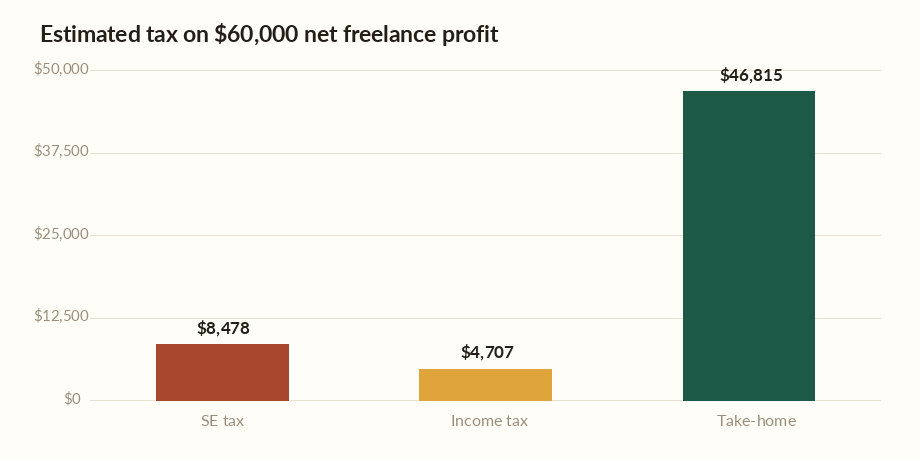
Freelancers face two separate taxes. The first is self-employment (SE) tax, which covers Social Security and Medicare. It applies to 92.35% of your net profit at a combined 15.3% — 12.4% for Social Security up to an annual wage cap and 2.9% for Medicare with no cap. On $60,000 of net profit that works out to roughly $8,478.
The second is federal income tax. You first subtract half of your SE tax and the standard deduction from your net profit, then apply the ordinary income tax brackets to what remains. The freelance tax calculator runs both steps and adds them together for a single estimated total.
Why freelancers owe more than employees
A traditional employee splits Social Security and Medicare with their employer, each paying 7.65%. A freelancer is both employer and employee, so they pay the full 15.3% themselves. That is the extra bite that surprises many first-year freelancers who were used to a W-2 paycheck.
The one break is that you can deduct half of your SE tax when figuring income tax, and you only pay on profit after legitimate business expenses — so tracking deductions carefully genuinely lowers the bill.
Set money aside and pay quarterly
Because no employer withholds tax for you, the IRS expects estimated payments four times a year. A common rule of thumb is to park 25% to 30% of every freelance payment in a separate savings account for taxes. The effective rate this calculator shows — about 22% on $60,000 — is a useful starting point, but going a little higher builds a cushion for state tax.
Missing quarterly deadlines can trigger an underpayment penalty, so treat the estimate here as a planning figure and adjust as your income changes through the year.
Important limitations
This is an estimate using 2024 single-filer rules and the standard deduction. It does not include state or local income tax, tax credits, other household income, a spouse’s earnings, or deductions such as a retirement contribution or the qualified business income deduction. Your real liability can be meaningfully different. For an accurate figure, use the IRS self-employment tax guidance or speak with a qualified tax professional.
Frequently asked questions
How much should a freelancer save for taxes?
A common guideline is 25% to 30% of net income. On $60,000 of profit this calculator estimates about 22% in federal tax alone, so saving closer to 30% leaves room for state tax and a safety margin.
What is self-employment tax?
It is the freelancer’s version of Social Security and Medicare tax, totaling 15.3% on 92.35% of net profit. Employees split this with an employer; the self-employed pay the whole amount but can deduct half when figuring income tax.
Do I have to pay taxes quarterly?
If you expect to owe $1,000 or more, the IRS generally requires estimated tax payments four times a year. Paying quarterly avoids an underpayment penalty at filing time.
Does this include state taxes?
No. The estimate covers federal self-employment and income tax only. Most states add their own income tax, so your total burden is usually higher than the figure shown here.
Use the freelance tax calculator to size your quarterly set-aside, then confirm details with the IRS self-employment tax guide and the U.S. Small Business Administration. For a wage comparison, try the hourly to salary calculator.