
Hourly to Salary Calculator
This hourly to salary calculator turns your hourly wage into annual, monthly, and weekly pay in one step. Enter your rate, the hours you work each week, and the weeks you work each year to see what your paycheck looks like as a yearly salary.
Hourly to Salary Calculator
How the hourly to salary calculator works
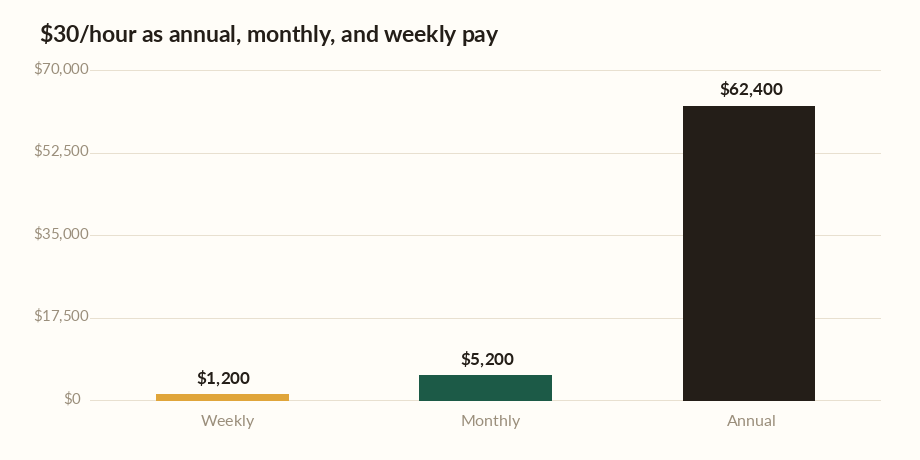
The hourly to salary calculator multiplies three numbers: your hourly rate, the hours you work per week, and the weeks you work per year. At $30 an hour, 40 hours a week, for all 52 weeks, that is $30 × 40 × 52 = $62,400 a year. Divide by 12 for the monthly figure ($5,200) and multiply rate by hours for the weekly figure ($1,200).
The weeks-per-year input matters more than people expect. If you take two unpaid weeks off, drop the figure to 50 and the annual total falls to $60,000 — a $2,400 difference from the same hourly rate.
Gross pay, not take-home
These figures are gross pay — the amount before federal income tax, Social Security and Medicare, state tax, and any benefits deductions come out. Your actual take-home pay will be noticeably lower. The exact gap depends on your filing status, state, and pre-tax deductions like a 401(k) or health insurance.
For a quick reality check, many workers keep somewhere between 70% and 85% of gross pay after taxes, though this varies widely. Treat the salary shown here as the headline number an employer would quote, not the amount landing in your bank account. If you are paid biweekly, you receive 26 paychecks a year; a semimonthly schedule pays 24. The annual total is the same, but each check differs, which is worth remembering when you line up rent or loan payments against your pay dates.
Why convert an hourly wage to a salary
Comparing job offers is the most common reason. A salaried role paying $65,000 sounds better than $30 an hour until you realize the hourly job, at 40 hours across 52 weeks, is worth $62,400 — close enough that benefits and overtime rules decide it. Converting to the same unit makes the comparison honest.
It also helps with budgeting and loan applications, which usually ask for annual income, and with setting freelance rates once you factor in unpaid time off and self-employment costs.
Where to learn more
The U.S. Department of Labor explains minimum wage and overtime rules that affect hourly workers, and the Internal Revenue Service provides a tax withholding estimator to see how much of your gross salary you actually keep. Both are free and authoritative.
Frequently asked questions
How do I convert hourly pay to annual salary?
Multiply your hourly rate by hours worked per week, then by weeks worked per year. For example, $30 × 40 × 52 = $62,400. A common shortcut for full-time work is to multiply the hourly rate by 2,080.
What is $30 an hour annually?
At 40 hours a week for 52 weeks, $30 an hour is $62,400 per year before taxes. Taking unpaid time off lowers that total because you work fewer paid weeks.
Is the result before or after tax?
Before tax. The calculator shows gross pay. Your take-home pay will be lower after income tax, Social Security, Medicare, and any benefit deductions.
How many work hours are in a year?
Full-time work is usually counted as 2,080 hours a year (40 hours × 52 weeks). Subtract unpaid holidays or vacation to get your actual paid hours.
Use the hourly to salary calculator to compare offers on equal terms, then check what you keep with an estimate of taxes. Authoritative wage and tax guidance is available from the U.S. Department of Labor and the IRS Tax Withholding Estimator.